

CR-8000 2026 Streamlines PCB Development With New Automation and Reuse Capabilities
New PCB design automation, placement analysis, and AI-assisted design reuse capabilities help reduce repetitive schematic and layout tasks.
Menu
WESTFORD, Mass., and MUNICH, Germany, Oct. 20, 2026 — Zuken announced CR-8000 2026, a new release of its PCB design platform that adds automation, placement analysis, and design reuse capabilities to support engineering productivity across schematic development and PCB layout.
Enhancements include automated schematic routing in Design Gateway, CR-8000’s schematic capture tool, and a new Main Path View in Design Force, its PCB layout tool. The release also expands Smart Design Reuse capabilities supported by Zuken’s Autonomous Intelligent Place and Route (AIPR) technology.
Automating Schematic Routing and Reorganization
CR-8000 2026 introduces automated schematic routing functionality in Design Gateway that simplifies the creation and reorganization of schematic connections. Engineers can establish a logical connection with a simple click sequence, allowing the software to automatically generate a clean, visually appropriate wire route.
The new logical connection capability also supports schematic changes without disrupting established logical connections. Users can temporarily unwire components, reposition or reorganize them, and automatically restore the wire routes once the new layout is complete. This shifts routine connection drawing to the software, helping engineers create and reorganize schematics more efficiently without having to manually rebuild each connection.
Simplifying PCB Placement Analysis With Main Path View
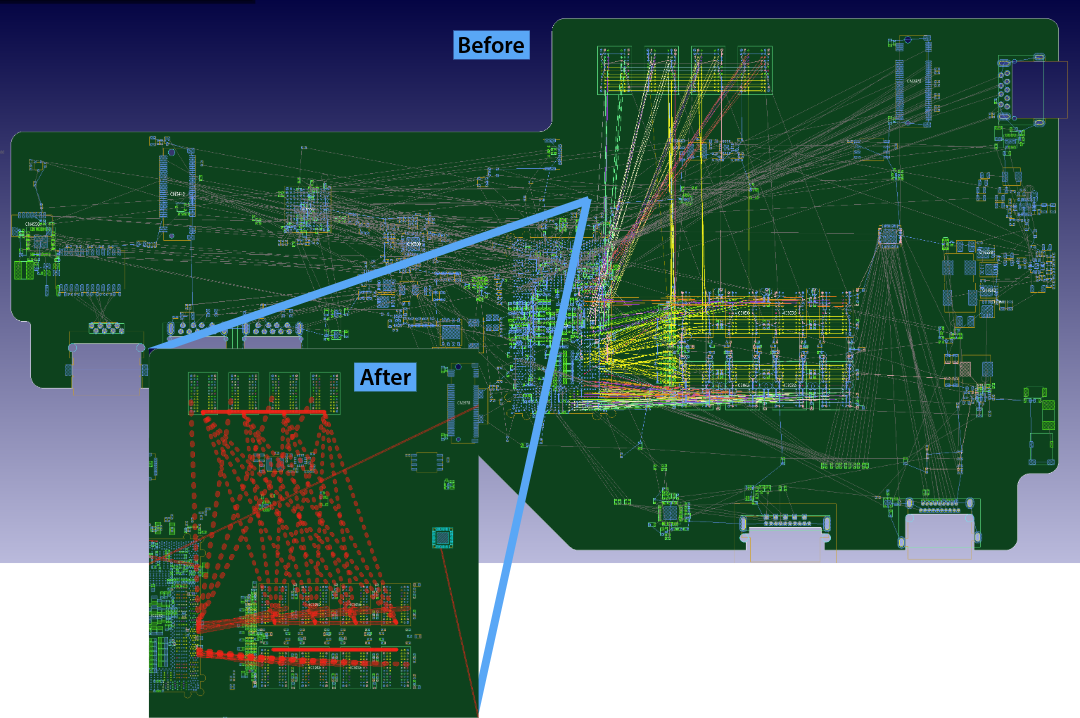
PCB layouts can contain a large volume of visual connection data, making it difficult to isolate the information most relevant to placement decisions. CR-8000 2026 addresses this challenge with the new Main Path View in Design Force.
Main Path View filters the PCB ratsnest to emphasize primary connections between major devices while suppressing connections to discrete components. This gives engineers a clearer view of critical connectivity for component placement and routing density decisions without repeatedly adjusting display settings.
The view can also represent constraints on connection distances between devices, helping engineers evaluate whether a placement candidate satisfies the defined requirements. Additionally, Main Path View can isolate on power-related connections, providing a focused view of the PCB power layout.
By surfacing relevant connectivity information, Main Path View supports placement evaluation and refinement without requiring engineers to manually isolate each connection type.
Accelerating PCB Layout Through AI-Assisted Design Reuse
CR-8000 2026 expands PCB design reuse with new Smart Design Reuse capabilities. Engineers can search existing design data for placement configurations used successfully in previous projects, compare available candidates for reuse, and apply a selected component arrangement directly to the current design. This reduces repetitive component-by-component placement by allowing teams to build on established design practices.
AIPR combines AI-assisted and machine-learning capabilities with other intelligent automation methods to support PCB placement and routing.
The new Dynamic Brain extends design reuse across engineering teams by making stored placement knowledge available through the locally hosted AIPR server. Because the placement data remains within the customer’s network environment rather than in the cloud, organizations can reuse design knowledge while maintaining control over where their design data is stored.
Additional AIPR Enhancements Expand Routing Control
The short-segment router now provides greater control over how routes are created. A new fanout function helps engineers route connections from high-pin-count devices to internal layers with less manual intervention. Additional AIPR enhancements continue to expand automation and user control across PCB workflows.
“Engineering teams are more productive when they can build on knowledge from successful designs instead of starting from scratch,” said Steve Watt, PCB engineering manager at Zuken USA. “CR-8000 2026 brings that knowledge into the design workflow while keeping the engineer in control of the design.”
Across CR-8000 2026, these enhancements reflect Zuken’s broader focus on automating routine design work, allowing engineers to spend more time on design decisions that require engineering expertise.
CR-8000 2026 is available now. For more information, visit Zuken’s What’s New page.

About Zuken
Zuken provides software for electronic and electrical engineering, systems engineering, and engineering data management. Its solutions support the development of printed circuit boards, electrical systems and wire harnesses, together with the management of associated engineering information. Founded in 1976, Zuken serves customers in industries including automotive, aerospace, industrial equipment and electronics. For more information, visit https://www.zuken.com/.
- Products
October 20, 2026
What's New in CR-8000 Release 2026
Zuken announced CR-8000 2026, a new release of its PCB design platform that adds automation, placement analysis, and design reuse capabilities to support engineering productivity across schematic development and PCB layout.
Read now
- Blog
September 04, 2026
Building Confidence in SERDES and DDR Performance Before Prototyping
Learn why SERDES and DDR PCB designs can pass routing checks yet fail during validation, and how earlier signal integrity and timing verification helps reduce late-stage problems.
Read now

- Blog
August 03, 2026
Understanding Eye Pattern Analysis for PCB Designers
Learn how eye pattern analysis helps PCB designers evaluate signal integrity, timing margin and high-speed communication channels. Discover how CR-8000 supports earlier signal integrity verification and eye diagram analysis.
Read now
- Blog
July 24, 2026
The PCB Passed Every Review. So Why Did the Product Fail?
PCB Design, Electronic, Blog
- Products
October 20, 2026
What's New in CR-8000 Release 2026
Zuken announced CR-8000 2026, a new release of its PCB design platform that adds automation, placement analysis, and design reuse capabilities to support engineering productivity across schematic development and PCB layout.
Read now
- Products
September 26, 2018
CR-8000
CR-8000 is a System-Level PCB & IC Package Design software including 3D Multi-board, Analysis and MCAD Integration
Read now
Advanced multi-board PCB design software