
Team collaborating over design project

Stakeholder Collaboration in Model-Centric Engineering

Extending a shared system context across roles, lifecycle stages, and organizational boundaries.
Menu

From Connected Systems to Connected People

A shared system context creates a consistent understanding of the system. Its value, however, remains limited if that understanding is confined to a small group of experts.

Engineering today requires the involvement of stakeholders across disciplines, functions, and lifecycle stages. Decisions are no longer isolated within engineering teams; they influence product management, manufacturing, operations, and service alike.

Model-Based Systems Engineering therefore must do more than structure system information. It must make that information accessible in a form that supports participation, collaboration, and decision-making across the organization.

Role-Specific Access to System Knowledge

Not every stakeholder needs the full system model, but everyone needs access to the relevant system context.

Model-centric environments enable structured access to system knowledge based on roles and responsibilities. Stakeholders interact with the system through views tailored to their needs, focusing on what is relevant while preserving the connection to the overall system.

This makes participation possible without requiring deep modeling expertise. At the same time, consistency and traceability are maintained, enabling broader involvement without increasing coordination effort.
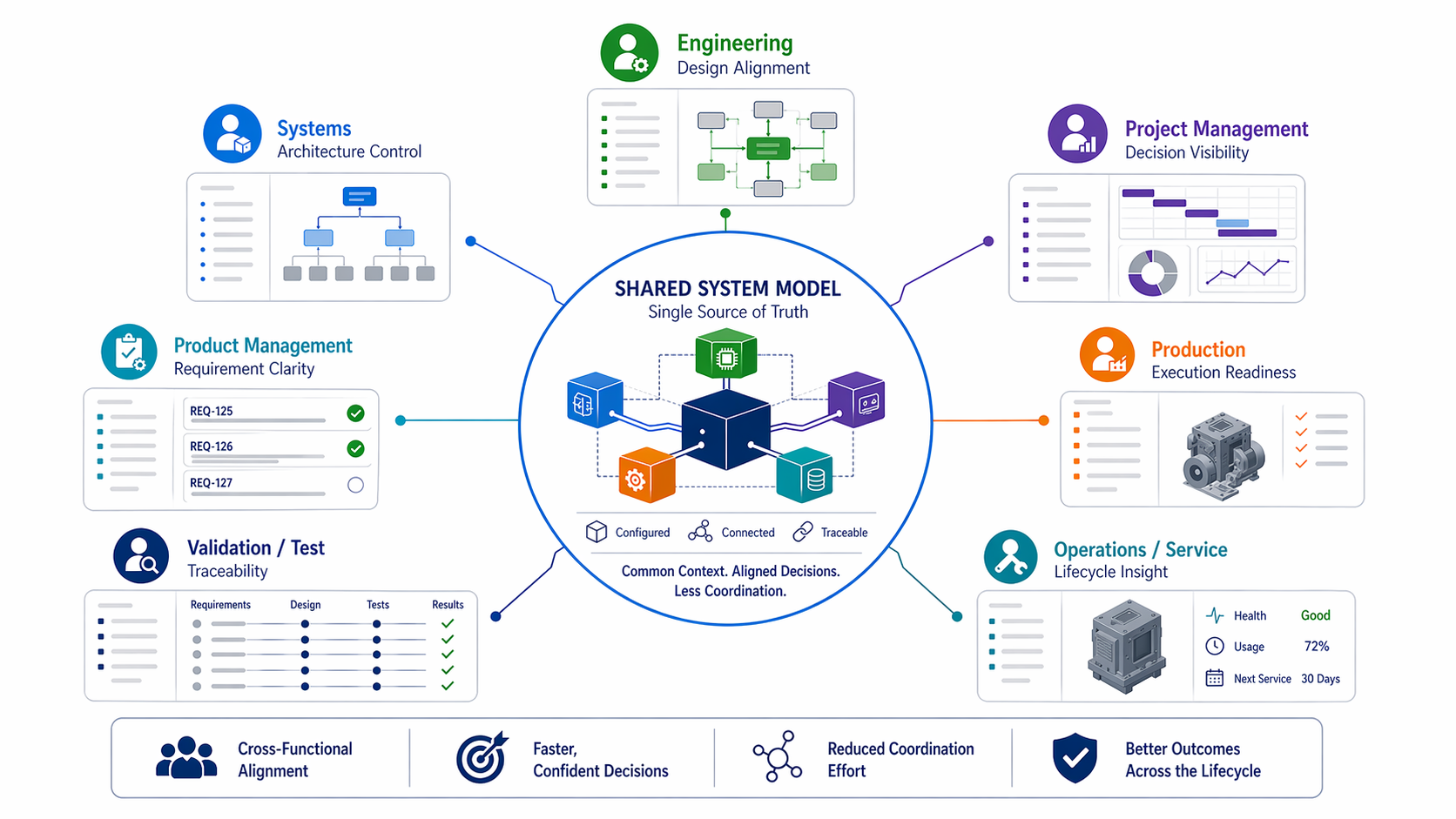
Shared system model connecting engineering, systems, project management, production, service, validation, and product management teams through role-specific views and traceable system context.A shared system context provides stakeholders across engineering, manufacturing, and management with access to consistent information, enabling aligned decisions, improved visibility, and coordinated execution.


Engineering becomes truly connected when decisions are made within a shared system context, improving alignment, reducing misinterpretation, and strengthening decision quality.

Structured Decisions in a Shared System Context

Collaboration improves when discussions and decisions are anchored in the shared system context. Instead of being scattered across documents or communication channels, they remain linked to the relevant system elements.

This ensures that decision rationale stays connected to requirements, architecture, and validation. As systems evolve, decisions remain understandable, traceable, and aligned, reducing the risk of misinterpretation.

Transparency and Alignment Across the Value Chain

A shared system model creates visibility across the entire lifecycle, from concept to operation. Stakeholders across engineering, product management, manufacturing, and service gain a consistent understanding of system intent.

This improves coordination and helps decisions remain aligned throughout development.

Collaboration can also extend beyond the organization. External partners and customers can be involved through controlled access to relevant system views.

This creates alignment across the full value chain and helps ensure that engineering decisions are consistently reflected in delivered products.


The greatest value emerges when system understanding is shared across people, lifecycle stages, and organizational boundaries, improving alignment, accelerating decisions, and reducing coordination effort.

Explore Industry Applications

See how model-centric engineering is applied across industries to manage complexity, improve coordination, and deliver more predictable outcomes.

Explore Industry Applications

Put Shared System Understanding into Practice

Discuss with a specialist how role-based access to a shared system context can improve stakeholder alignment, enable better decisions, and reduce coordination effort.

Start the Conversation