
Future-Proofing E3.series Automation in a Post-VBS World
Menu
Automation has long been a cornerstone of efficient work with E3.series, enabling organisations to reduce manual effort, standardise processes, and integrate electrical design data into wider engineering and IT environments. As automation becomes increasingly central to productivity and scalability, the technologies used to implement it must evolve in line with modern software ecosystems.
The Changing Technology Landscape and the End of VBS
In recent years, Microsoft has announced the deprecation of Visual Basic Script (VBS), a technology that has traditionally been used for many E3.series automation tasks. While alternatives such as C# offer a technically robust path forward, they often introduce a level of complexity that exceeds the requirements of everyday automation and rapid solution development. Against this backdrop, Python has emerged as a natural and future-oriented successor.
Python as a Modern and Sustainable Foundation
Python is now one of the most widely adopted programming languages worldwide, valued for its clarity, flexibility, and extensive ecosystem. By providing an official Python package for E3.series, Zuken enables customers to preserve their existing automation concepts while transitioning to a more modern and sustainable development environment. Since E3.series version 26.10, each product release has been accompanied by a corresponding Python package, ensuring compatibility, continuity, and long-term support.
Importantly, this transition does not alter the underlying automation capabilities of E3.series. The same application programming interface remains available, conceptually identical to what users know from VBS or C#. What changes is the way in which this interface is accessed: Python introduces clearer syntax, more natural data handling, and modern language conventions that significantly improve readability and maintainability.
A Practical Perspective: Automation with Visual Basic Script
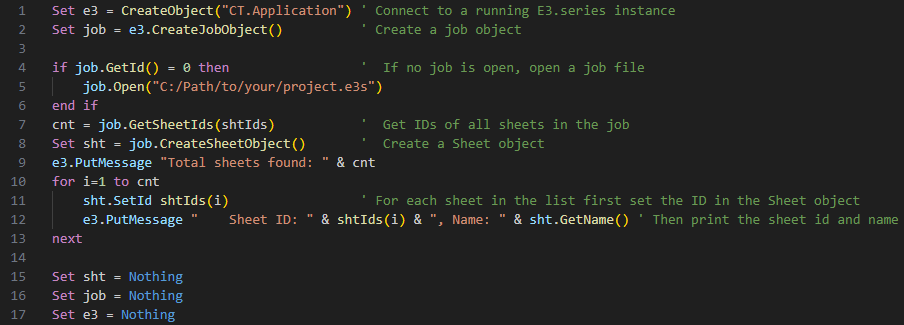
The following example illustrates a typical automation task as implemented in VBS. The script connects to a running E3.series instance, opens a project if none is currently loaded, retrieves all sheets in the job, and outputs their identifiers and names.

While this approach remains functional, Python enables the same task to be expressed more clearly and concisely, reducing technical overhead and making automation logic easier to understand and evolve. The Python interface benefits from modern language features such as native lists, simplified iteration, and multiple return values, all of which contribute to more robust and readable scripts.
A Development Experience Designed for Today’s Engineers
Beyond the direct API access, the E3.series Python package introduces additional convenience and safety features that support productive day-to-day automation. These include controlled handling of E3.series startup and connections, formalised enumerations for API constants, and built-in safeguards that help prevent common scripting errors. As a result, automation solutions become not only faster to develop, but also more reliable over time.
The Python interface integrates seamlessly with modern development environments such as Visual Studio Code, providing intelligent auto-completion and contextual information directly within the editor. This significantly lowers the barrier to entry for new users and accelerates productivity for experienced teams, allowing them to focus on engineering challenges rather than tooling complexity.
Getting Started Quickly with Practical Examples
To support rapid adoption, we offer a dedicated GitHub repository containing comprehensive documentation and practical examples. These resources guide users from initial environment setup through to real-world automation scenarios, enabling organisations to realise value quickly and with confidence.
We hope you enjoy the new possibilities as much as we do!

-
Software Engineer

Patrick Rausenberger is a Software Engineer at Zuken. With over six years of experience in E3.series core development, his work focuses on improving and extending E3.series functionality. Patricks areas of expertise include DXF/DWG processing, the COM interfaces, the E3.ProjectConfigurator, AI topics around E3.series, and Python library development.

- Blog
March 10, 2026
E3.series Dynamic Cables: Cores, Shields, Twisted Pairs
Build accurate dynamic cables in E3.series by defining cores, shields, and twisted pairs so schematics, reports, and formboard outputs stay consistent.
Read now
Mastering E3.series #8
- Blog
January 26, 2026
E3.series Levels: Control Visibility and Hide Part Numbers
Use Fields in E3.series to stop splitting designs across multiple pages, keep device inheritance correct, and generate clean reports when multiple functions share one sheet.
Read now
Mastering E3.series #7
- Blog
January 23, 2026
E3.series Fields Basics: Group Data on a Single Sheet
Use Fields in E3.series to stop splitting designs across multiple pages, keep device inheritance correct, and generate clean reports when multiple functions share one sheet.
Read now
Mastering E3.series #6
- Blog
December 10, 2025
What Can Go Wrong with Wire Lengths, Diameters, and Offsets
Despite the best intentions of design engineers, seemingly perfect schematics can unravel the moment they hit the shop floor, especially in wire harness and control cabinet manufacturing. When tiny oversights spark major production headaches, the real question becomes: how can smarter design tools finally close this costly gap?
Read now