CR-8000 Raises The Bar For ECAD/MCAD Colloration
Zuken Raises The Bar For ECAD/MCAD and Multi-user Efficiencies With CR-8000
7 June 2016, Munich, Germany & Westford, MA, USA – Engineers facing extremely tight design cycles will benefit from powerful new multi-user functionality in Zuken’s CR-8000. Concurrent PCB design reduces design time, meaning quicker time-to-market. In addition, a raft of native 3D design enhancements offer more efficient ECAD/MCAD task management and design re-use, plus functionality enabling early validation to reduce iterations and improve design quality.
Zuken’s CR-8000 is the industry’s only 3D product-centric design solution with architecture design, concurrent 3D multi-board support, and chip/package/board co-design. CR-8000 2016, the latest update, is available now.
Concurrent multi-area PCB design
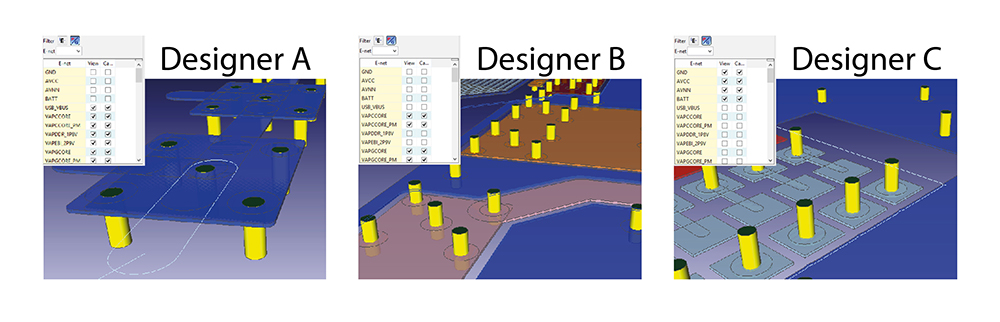
Teams can work on the same design area and at exactly the same time with concurrent multi-area PCB design. Designs can be modified simultaneously, reducing the overall design time and making best use of globally-dispersed teams. Each engineer can control their own viewpoint, and has continual and instantaneous visibility of the design and any remaining unconnected nets.
Improved part swap capability
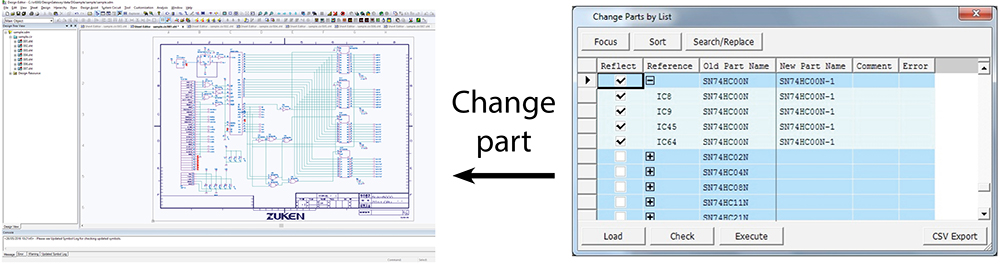
Design effort is dramatically reduced with improved part swap capability. Superseded or highlighted parts can be viewed directly within the circuit data, and changed collectively. This avoids time-consuming manual checks for part swaps and enables designers to start at any point, swapping out parts as the design progresses without being concerned about missing an instance of a superseded part.
3D ECAD/MCAD efficiencies
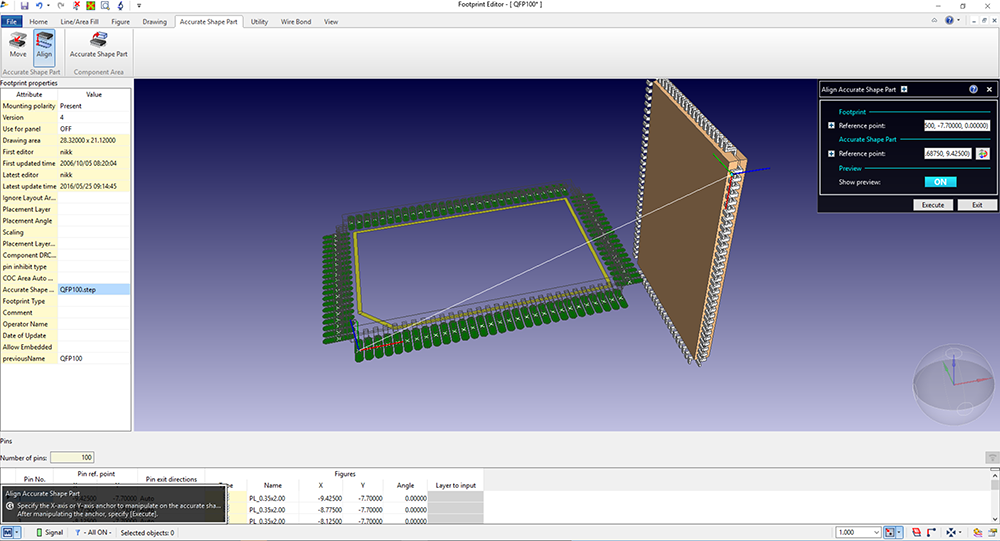
True 3D STEP models are now defined within the library at the component level. Once that component is selected the 3D model will automatically become part of the PCB design. Origin alignment is managed, ensuring a common reference point between the ECAD and MCAD libraries and alignment of the 3D shape to the component footprint. An accurate 3D component model for output to MCAD is supported, with export of whole or subset designs.
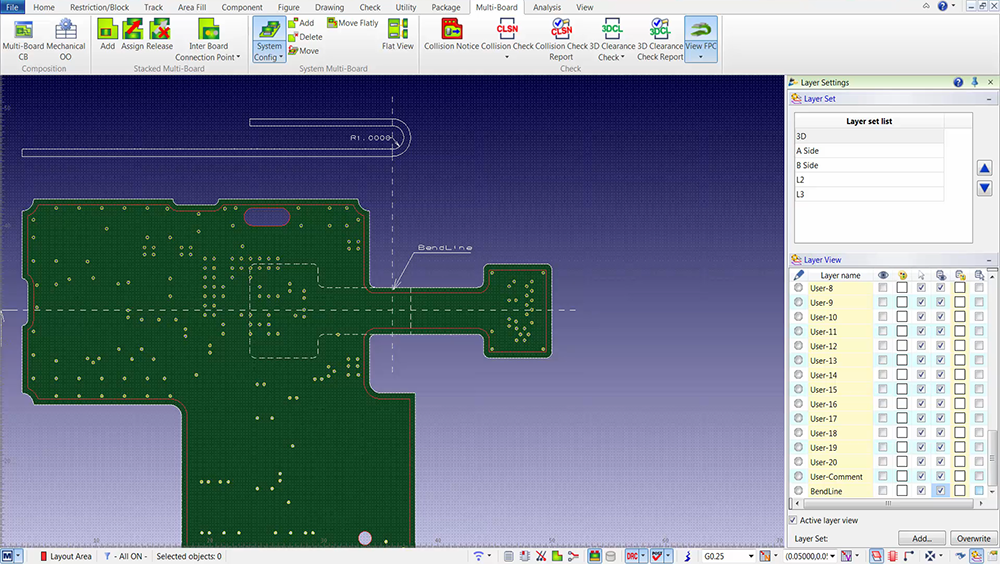
With rigid-flex product visualization and design validation checks, the bend of the flex board can be modeled and collisions viewed to check design issues, with the product modeled to final state condition. This avoids design re-work and iterations between mechanical and electrical design.
Maximize re-use with modular design
Designers have more power to utilize known-good circuits, with new search and re-use capabilities for modular block selection. Module attributes can be added to the block for characterization so faster and more efficient selection can be realized. Building on existing constraint re-use functionality, constraint arbitration allows users to view a section of the block and easily see conflicting constraints, as well as define which information to preserve within a design by constraint or object.
For more information, see www.zuken.com/cr-8000
– ends –
- Blog
September 04, 2026
Building Confidence in SERDES and DDR Performance Before Prototyping
Learn why SERDES and DDR PCB designs can pass routing checks yet fail during validation, and how earlier signal integrity and timing verification helps reduce late-stage problems.
Read now

- Blog
August 03, 2026
Understanding Eye Pattern Analysis for PCB Designers
Learn how eye pattern analysis helps PCB designers evaluate signal integrity, timing margin and high-speed communication channels. Discover how CR-8000 supports earlier signal integrity verification and eye diagram analysis.
Read now
- Blog
July 24, 2026
The PCB Passed Every Review. So Why Did the Product Fail?
PCB Design, Electronic, Blog

- Press Release
July 07, 2026
Zuken Joins TSMC’s Open Innovation Platform® EDA Alliance
Zuken Inc. today announced that it has joined the EDA Alliance in TSMC’s Open Innovation Platform® (OIP). TSMC collaborates with its OIP EDA Alliance partners to address growing design demands, accelerate adoption of latest process and packaging technologies, and enable customers to achieve their PPA and time-to market targets.
Read now