genesys2022_bkg-1510x650

What's New in GENESYS 2025

Menu

GENESYS 2025 delivers powerful new capabilities designed to enhance model-based systems engineering (MBSE) workflows, improve interoperability, and support industry standards. This release introduces major innovations that make system modeling more intuitive, accessible, and collaborative.

New features of GENESYS 2025 include:

genesys-logo-on-white-444x485-1-293x320

Containment: Model Organization for Greater Interoperability

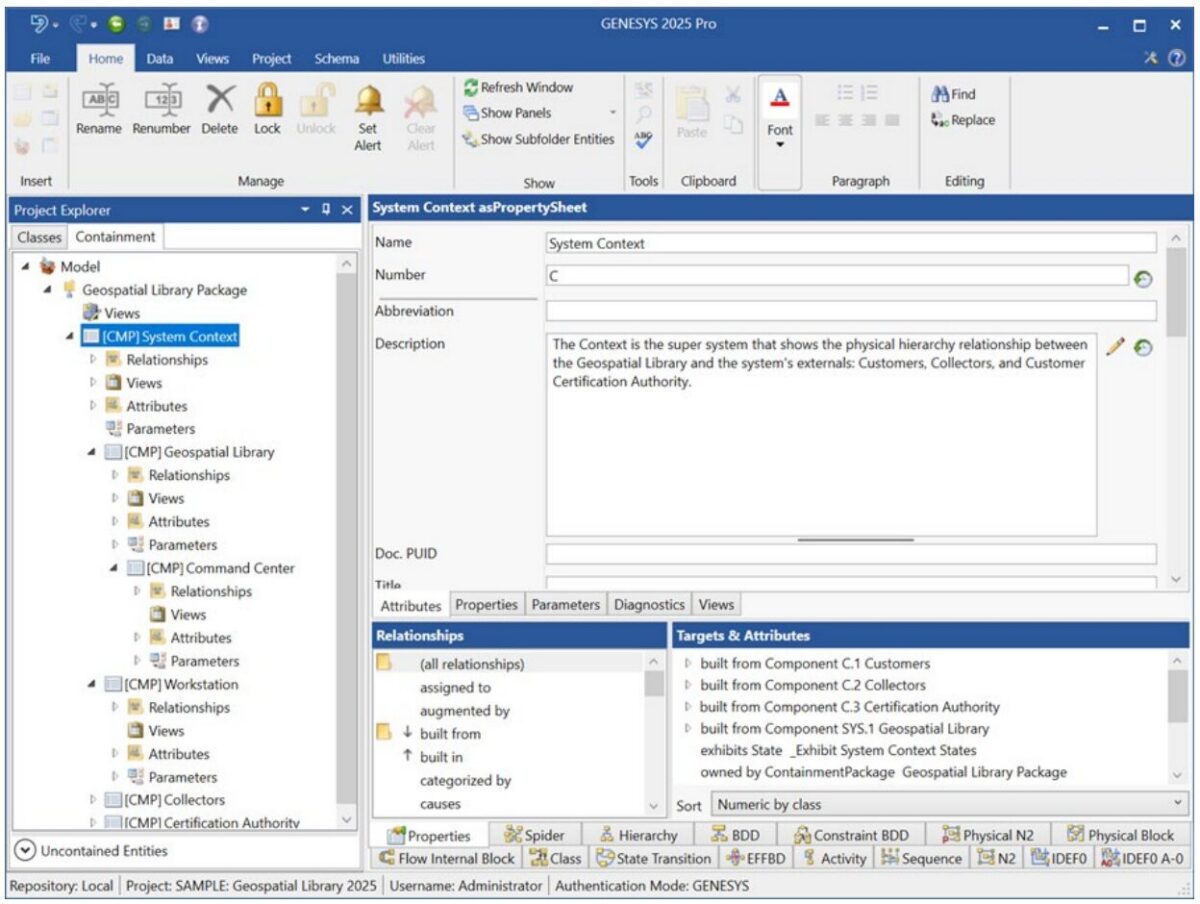
At the heart of GENESYS 2025 is the introduction of containment, a transformative approach to model organization. Containment allows users to structure engineering data in a way that aligns more naturally with user intent and industry best practices.

Key Benefits:

  • Intuitive Navigation: Easier to explore and manage complex system models.
  • Standards Alignment: Supports widely adopted data exchange standards.
  • Enhanced Interoperability: Seamless collaboration across MBSE tools and teams.

To access the Containment View, click on the Containment tab at the top of Project Explorer.

genesys-whatsnew2025-2

Additional capabilities supporting the Containment View include:

  • Jump to Entity in Containment View – From the context menu on an entity (right-click), you can select this option and navigate directly to the selected entity in the Containment View.
  • Uncontained Entities – Provides a list of all entities that do not currently exist in the Containment View (i.e., lack the Owns/Owned By relationship).


genesys-whatsnew2025-4

Full Control Permission Option on New Projects

Users can now automatically give the Administrators group full control permissions on new projects at the time of creation. This option is checked by default and helps streamline administrative processes for enterprise customers.

genesys-whatsnew2025-5

Unified Architecture Framework (UAF) Support with built-in guidance

GENESYS 2025 incorporates robust support for the Unified Architecture Framework® (UAF®), a standard developed by the Object Management Group® (OMG®) to support mission engineering and enterprise architecture.

The new UAF features include built-in modeling guidance that assists users in correctly applying the UAF methodology. Additionally, there are normative diagram samples that help accelerate learning and adoption. These new features streamline the user experience, particularly for new UAF users.

These enhancements lower the barrier to entry for organizations adopting UAF, enabling teams to build effective, standards-compliant architectures from day one.

Schema Updates

Summary of changes to the default schemas:

  • Requirement class: The “Composite” enumeration of the Type attribute in the has been removed and replaced with a separate Boolean attribute called “Is Composite?” This allows the user to declare a requirement as composite while still assigning it to a general type.
  • The formerly optional “Standards Compliance Schema” has now been formerly incorporated into the GENESYS 2025 Base Schema and Capability Schema. This includes a new class and several new relationships that allow the user to better trace to standards if needed.
  • Removal of the Service Specification
  • Minor changes to the Review class to better support integration with Sidekick.
  • General UAF relationship updates and error corrections to better align with the UAF 1.2 Specification.

Rest API Enhancements

New endpoints have been added to the GENESYS 2025 REST API expanding access to GENESYS models.

Previous Version History

GENESYS 2024 delivers measurable improvements across the MBSE lifecycle:

  • Simplified deployment and expanded hardware support
    Removes the dependency on SQL Server Express for local repositories, enabling easier installation and compatibility with a wider range of systems, including ARM-based architectures.
  • Enhanced standards compliance
    Adds support for Unified Architecture Framework (UAF) 1.2, improving alignment with defense and other regulated industry requirements.
  • Improved project organization and governance
    Introduces a redesigned project structure with better navigation, searchability, and governance capabilities, including Query to Package and enhanced view management.
  • Significant performance improvements
    Accelerates matrix operations and large diagram loading, with notable gains for remote repository environments.
  • Increased modeling efficiency and usability
    Enhances diagram interaction and enables more efficient relationship editing directly within table views.
  • Extended integration and customization capabilities
    Introduces a new Add-In Framework and API enhancements to support digital thread integration and third-party extensibility.
  • Strengthened reliability and risk analysis
    Expands the FMEA schema to enable integrated reliability and risk assessment within the system architecture model.

For full details, including schema updates, connector enhancements, and the complete list of resolved issues, access the PDF release notes.

What’s New in GENESYS 2024

GENESYS 2023 R2 strengthens digital thread integration, traceability analysis, and platform stability:

  • Enhanced traceability and relationship analysis
    Expands Matrix View capabilities to provide a more powerful and interactive way to visualize and manage relationships across requirements, functions, and physical architecture.
  • Interactive matrix-based modeling
    Enables dynamic scope adjustment and direct relationship creation within the matrix, supporting verification of allocation completeness and traceability coverage.
  • Improved digital thread integration
    Updates the SBE Vision Connector to support enhanced round-trip data exchange, clearer synchronization control, multiple subscription handling, and improved management of digital thread channels.
  • Formalized digital thread data mapping
    Introduces the Digital Thread Package class to define how GENESYS entities map to external repositories, ensuring consistent one-to-one data alignment.
  • Expanded automation capabilities
    Adds command-line project launching to support scripting and automated workflows.
  • Improved modeling clarity and consistency
    Refines CSDL relationship terminology for clearer semantics and more consistent usage across models.
  • Increased platform stability and reliability
    Resolves a wide range of issues across security administration, simulation behavior, search accuracy, spell checking, table views, licensing, and repository management.

For full details, including feature descriptions and the complete list of resolved issues, access the PDF release notes.

What’s New in GENESYS 2023R2

GENESYS 2023 introduces structural product updates, improved model usability, enhanced performance, and stronger digital thread integration:

  • Updated product portfolio and licensing model
    Formalizes the GENESYS product family (GENESYS, GENESYS Pro, GENESYS University Edition, and GENESYS Server) with new Server packaging and Universal Connection License management to support scalable, collaborative environments.
  • Enhanced model navigation and usability
    Introduces Independent Views, native Table Views, and structured View Lists, enabling real-time tabular editing and improved organization of diagrams through pinned, favorite, filtered, and custom views.
  • Secure model sharing capabilities
    Adds a Model Obfuscator to enable the export of redacted models while preserving structural integrity.
  • Improved diagram navigation
    Introduces Zoom to Fit functionality for faster orientation within complex diagrams.
  • Integrated digital thread connectivity
    Enables participation in configuration-managed digital engineering environments through integration with the SBE Vision Digital Thread platform using publish/subscribe mechanisms.
  • Performance improvements for large models
    Delivers measurable gains in bulk operations, including entity creation, relationship management, and drag-and-drop interactions.
  • Streamlined platform operations and API enhancements
    Adds automatic license updates, consolidated undo/redo handling for bulk operations, and updates to the API, including REST API v2.
  • Consolidated issue resolution
    Incorporates resolved issues from GENESYS 2022 SP1 and SP2 to improve overall platform stability.

For full details, including feature descriptions, API changes, and the complete list of resolved issues, access the PDF release notes.

What’s New in GENESYS 2023

GENESYS 2022 delivers major improvements in usability, standards alignment, performance, and collaboration across the MBSE lifecycle:

  • Enhanced diagram productivity and visual clarity
    Introduces automatic rule-based Diagram Legends, advanced line routing and distribution controls, improved port anchoring, flexible label positioning, and full undo/redo support for diagram actions—reducing manual effort in complex architectures.
  • Strengthened methodology and standards alignment
    Expands Model Assistant rules, including automated creation of primary functions for use cases and root functions for states, improving traceability across behavior, structure, and abstraction levels. Activity diagrams are updated for closer alignment with SysML v1.
  • Extended verification modeling capabilities
    Replaces Test Activity with Verification Activity to support analysis, demonstration, and inspection. Additional relationships and attributes improve alignment with external verification and project management tools.
  • Improved collaboration and model management
    Enhances team workflows with smart package import (load or instantiate modes), project statistics dashboards, view overwrite protection, improved RDF generation, and more efficient drag-and-drop relationship management.
  • Significant performance and scalability improvements
    Reduces project and diagram load times, improves GUI and server communication, optimizes script execution over networks, and enhances administrative tool performance. Transition to 64-bit architecture increases scalability and memory utilization.
  • Increased platform stability and reliability
    Resolves a wide range of issues across simulation, connectors, import/export, reporting, TeamView, schema migration, and overall system stability.

For full details, including feature descriptions and the complete list of resolved issues, access the PDF release notes.

What’s New in GENESYS 2022