genesys-background-19a-1510x320

MBSE Analysis and Simulation

Validate system behavior, reduce risk, and optimize performance across the engineering lifecycle
Menu

Integrate Analysis and Simulation into the Engineering Process

When documenting an existing product or process, a series of architectural diagrams may be sufficient to communicate understanding. Engineering a new system, or re-engineering an existing capability, requires far more than static views or descriptive architecture in isolation. It is easy to design the impossible and far more difficult to build. Integrating analysis and simulation into systems engineering enables early validation, identifying defects and confirming feasibility from day one to accelerate development and reduce risk.

Analysis and simulation take many forms, bringing rigor and decision support into the engineering process. A key promise of MBSE and digital engineering is continuous verification and validation across the lifecycle. GENESYS enables this from the earliest stages of system definition, from mission and concept through to detailed design. Engineers can highlight critical design information, simulate behavior, perform trade studies, and execute performance analysis while maintaining consistency across the system model and ensuring alignment between requirements, behavior, and implementation.

Reduce Technical Risk Through Continuous Model-Based Validation

Eliminate early-stage defects with integrated diagnostics.

Effective systems engineering requires both creative exploration and rigorous control of completeness and consistency. Relying on external checks or late-stage validation introduces risk and delays. Instead, continuous, model-integrated feedback ensures issues are identified and resolved as the design evolves.

GENESYS provides automated diagnostics directly within the modeling environment, enabling engineers to detect incomplete requirements, missing relationships, and inconsistencies in real time. Identify requirements that have not been satisfied, uncover design decisions lacking rationale, and expose integrity issues across behavioral and physical architectures. As models mature, diagnostics can be tailored to increase rigor, ensuring design quality scales with system complexity while maintaining alignment across the lifecycle.

Accelerate through the power of executable architectures and embedded simulation.

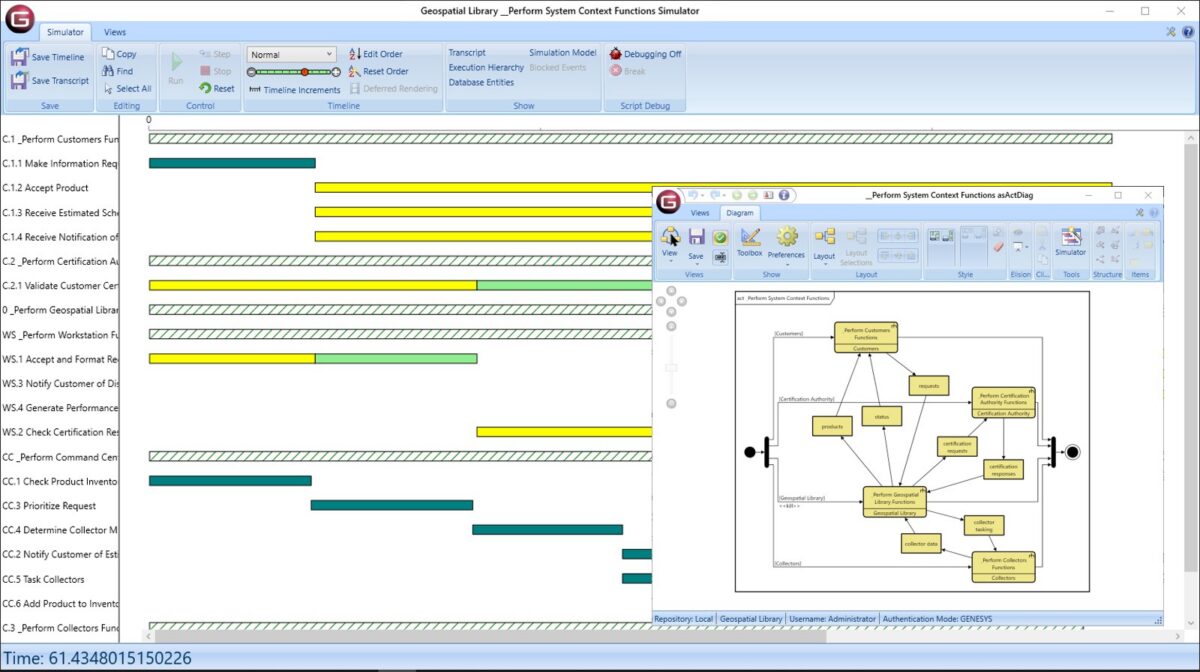
Done right, model-based systems engineering allows you to validate your system continuously throughout design. Built upon a strong semantic foundation, Vitech tools allow you to simulate your behavior from the first moment of design, allowing your system model to serve as a virtual system prototype. Far more than animation, this simulation checks for deadlock conditions, timing, resource contention, and overloaded links. When problems arise, debug your system logic directly rather than debugging a disconnected simulation that may or may not accurately represent the full depth of your system specification.

Integrate architecture and analysis for the appropriate level of engineering rigor.

In systems engineering, design-dependent variables define system performance and ultimately project success. Too often, these critical values are either embedded as text within architectural descriptions or managed disjointly from the system design. GENESYS exposes these design parameters while maintaining integration with and integrity of the system design. Manage the objectives, threshold values, as-designed, and as-built state. Integrate with analytic tools such as MATLAB and Phoenix ModelCenter to bring even more analytic rigor, or connect to detailed design tools such as Zuken’s E3.series for connected design and increased fidelity.

Enable real-time trade studies to expand the solution space.

Interactions within complex systems make it difficult, if not impossible, to predict system performance a priori. Establishing architectures and design parameters without good analysis and analytic verification is fraught with risk. GENESYS provides critical insight into implicit architectural interactions that govern system performance. Combine this insight with native parametric and multi-design support to conduct real-time design trades between key design parameters, across solution architectures, and across subsystems as design issues emerge. Identify and address issues early with analytics-based evidence of the goodness of your solution.

Book your FREE MBSE Readiness Assessment

Enhance collaboration, efficiency and accuracy in your design process though use of GENESYS, MBSE. Let's discuss how MBSE can help your business needs.
Request your FREE MBSE Consultation