
Moving Beyond “Experience and Intuition”
Article 5 in our series Executives’ Perspectives on Digital Transformation by Yasuo Ueno, Senior Managing Executive Officer and Head of Business Strategy, Zuken Inc.
As mentioned in our previous article, ultimately, complexity is not the enemy – poor complexity management is. As products, portfolios, and value chains continue to grow in scale and interdependence, manufacturers need a disciplined, model-based approach to manage complexity without losing speed or control. MBSE provides the foundation for turning complexity management into a sustainable competitive advantage.
In our last article, we explained the application of MBSE in plant engineering. Specifically, by shifting from document- and bill-of-materials (BoM)-based work methods to a model-based approach, companies are able to analyze the plant from a functional product perspective, easily identify and optimize synergies and redundancies, and accelerate the proposal and order processing workflow.
This time, we will introduce HIRANO TECSEED Co., Ltd.
As a representative example of made-to-order industrial equipment in Japan, HIRANO TECEED is a developer and manufacturer of coating machinery that provides integrated production lines covering coating, drying, and winding onto substrates such as plastic film and metal foil. Products made using its equipment are used in diverse fields, including lithium-ion batteries, liquid crystal displays, ceramic capacitors, and more.
While the company has traditionally leveraged its strength in customer-specific customization, it now faces international market competition, with overseas markets accounting for 70% to 80% of its sales. Within this context, a key challenge was the reliance on individual expertise for specification review during the quotation design phase, which bridges sales and detailed design.
The key role MBSE played in streamlining the quotation design process and eliminating this dependency Is therefore of particular interest.
To prevail in international competition: a shift from customization to standardization
For many years, HIRANO TECSEED believed that the mission of an industrial equipment manufacturer was to provide meticulous customization tailored to each customer’s specific needs. Consequently, the company was reluctant to standardize its products. However, entering the 21st century, the market environment changed dramatically, with 70 to 80 percent of sales becoming exports, forcing the company to face intense international competition. Driven by a sense of crisis that survival would be impossible without greater design and manufacturing efficiency and standardization, the company decided to push forward with digitalization.
Until then, the company had improved the efficiency of detailed design and manufacturing processes after order intake through PLM implementation and the use of 3D data. However, the upstream quotation design phase remained highly dependent on individual expertise. Decisions on how to meet customer requirements during specification discussions relied heavily on the knowledge, experience, and memory of the personnel involved, often lacking clear justification.
This very issue became a bottleneck for sales in overseas markets, where efficient order acquisition is essential. Consequently, the company sought a method to eliminate this dependency on individuals and enable the efficient, organization-wide sharing of the specification decision process and its underlying rationale.
The turning point came when the company’s CTO and project owner, Mr. Omori, attended a presentation on MBSE and its modeling tool ‘GENESYS’ at Zuken Innovation World 2023.
The presentation focused on electrical design case studies, but it became evident that the MBSE approach – translating requirements into specifications – could also be applied to mechanical design. By visualizing the underlying reasoning – how customer requirements are interpreted and why specific specifications are selected – could the company recognized the potential not only to eliminate dependency on individual expertise but also to support technology transfer and talent development. This marked the beginning of its consideration to introduce GENESYS.
The challenges Mr. Omori identified at the company were “person-dependent processes” and “excessive variant proliferation”. The quotation design phase serves as the gateway to engineering, bridging sales and detailed design. It is a critical process in which the feasibility of customer requirements is assessed and optimal specifications are selected.
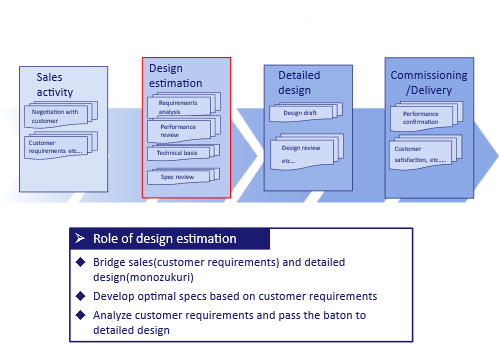
However, extensive implementation experience across diverse industries has revealed the following challenges:
- Lengthening of specification review due to reliance on individual expertise: As products became more sophisticated and complex, dependence on the knowledge and experience of specific individuals increased. The lead time required to locate necessary information and translate it into specifications grew longer.
- Increasing complexity of specifications due to variant proliferation: The casual reuse of past work and specification decisions reliant on individual experience led to the accumulation of ad hoc adjustments labeled “for the XX industry” or “per XX customer specifications” often without clear justification. This resulted in a significant proliferation of similar variants.
- Increased costs due to unnecessary special specifications: Referencing disparate historical specifications for each subsystem resulted in the loss of overall line optimization. As a result, unresolved issues were carried forward, and the continued adoption of unnecessary special specifications drove up costs.
To address these challenges, the company decided to adopt a new design philosophy: “subtractive design” as its guiding approach.
This approach defines a standard machine as a 150% baseline specification equipped with a full range of functions and then examines specifications not through addition but through systematic subtraction. By doing so, it established a unified source of reusable components, helping prevent dependency on individual expertise and facilitating technology transfer.
Using MBSE methodologies to accumulate tacit knowledge as “technical foundations”
In HIRANO TECSEED’s design approach, the Bill of Materials (BOM) has traditionally been used to represent equipment configurations in a tree structure, enabling unit-level improvements and reuse. However, the BOM alone could not capture the technical rationale for selecting specific units or components, leaving a critical gap in which the effective use of accumulated data remained dependent on individual expertise.
To address this limitation, the company aimed to complement the BOM with MBSE methodologies, thereby reducing reliance on individual expertise in specification determination.

Using GENESYS, the company accumulates technical justifications – including customer needs and the rationale behind design decisions – to conduct evidence-based reviews. This approach allows the derivation of specifications with reduced reliance on individual expertise and improves specification accuracy. By formalizing the tacit knowledge residing in practitioners’ minds, this process reduces time spent deliberating over specification choices during reuse and improves reuse rates.
GENESYS class definitions contain many unfamiliar terms, so they were “translated” into terminology aligned with the company’s internal operations. For example, Requirement was defined as ’customer and internal requirements‘ and Component as “manufacturing elements that constitute machinery,” in order to reduce the barrier to using the tool.
In the class definition, various unit options corresponding to the 150% baseline specification are predefined. When finalizing a specification, entities (i.e. individual elements constituting the model) that are not required are explicitly disabled via parameters and excluded, thereby completing the specification.
This approach minimizes the use of free-text descriptions, reducing individual bias while linking technical rationale to the predefined selection items. It also makes the basis for selecting a specific specification transparent and traceable.
Furthermore, customer-specific notes are explicitly linked to the relevant configuration elements. When reusing specifications, these links can be removed, preventing the unintended carryover of unnecessary special specifications.
Roadmap for Business Transformation: Expectations for GENESYS Operation and Technology Transfer
HIRANO TECSEED is its efforts to transition the PoC with Zuken into actual business workflows. The company is currently defining operational specifications – including new business processes and management rules – for quotation design using GENESYS. The ultimate objective is to generate specification outputs as formal deliverables based on these configuration methods and operational rules, and to integrate them in standard processes.
However, several challenges must still be addressed before full implementation. The first is the optimization of customer requirement analysis and interpretation. As customer requirement specifications vary significantly in description and detail, it is necessary to introduce questionnaire based on GENESYS registration items to consistency in the information collected.
Another key challenge is the establishment of internal deployment and training methods. To ensure system control, usage is to be limited to a small number of designated GENESYS operators, supported be appropriate governance and monitoring mechanisms to prevent ad-hoc usage. In addition, operational approaches are being considered to reduce the burden on users – for example enabling data import into GENESYS from their familiar tools like Excel, rather than requiring users to interact directly with the systems.
Mr. Toma, the lead for the project implementation, stated as follows: “To reduce the workload and improve understanding of GENESYS operations, we believe it is crucial to lower the difficulty level through ’translation‘ and to establish administrators and dedicated personnel for operational coordination. Furthermore, modeling real projects and demonstrating successful examples are effective means of promoting understanding among practitioners.
Further refinement of operations is also necessary. With a view toward integration with the BOM, specifications we must be revised to achieve optimal documentation. Optimizing methods for collecting customer information and creating an environment where the system can be fully utilized are also critical.
While we are still only halfway there, we aim to build a more effctive workflow through the realization of these goals and continuing to collaborate with Zuken.”
The company’s BOM, VisualBOM, is a product called for which Mr. Toma had lead the product development. It incorporates compressed 3D data and provides built-in support for modular design. However, as HIRANO TECSEED points out, unless modules are rigorously defined, BOM and 3D alone cannot capture the technical rationale for selecting units or components, and a degree of subjectivity remains in configuration decisions.
Mr. Toma considers the use of MBSE to address these limitations of the BOM to be a highly promising approach. He plans to continue working with the company to develop a concrete solution that integrates MBSE and BOM.
Such an integrated solution could subsequently be released as a package offering, based on further validation and refinement with customers. At the same time, the underlying concept and implementation approach is not limited to a specific BOM system and can be applied in conjunction with existing solutions.

- Blog
Executives’ Perspectives on Digital Transformation #6

- Blog
Explore why traditional “best guess” engineering approaches fall short in an unpredictable world and how integrating strategic foresight into Model-Based Systems Engineering (MBSE) helps build systems that remain valuable and adaptable over time.

- Blog
Why is Model-Based Systems Engineering becoming essential for modern development? Learn how MBSE transforms complexity into clarity, speed, and competitive advantage.

- Blog
Executives’ Perspectives on Digital Transformation #3
Also in this series
- Blog
Why is Model-Based Systems Engineering becoming essential for modern development? Learn how MBSE transforms complexity into clarity, speed, and competitive advantage.
- Blog
Executives’ Perspectives on Digital Transformation #3

- Blog
Executives’ Perspectives on Digital Transformation #2 The Productivity Paradox

- Blog
Executives’ Perspectives on Digital Transformation #1 Building Dynamic Capabilities for Product Success in a Changing World