
Implementing STRATA MBSE Methodology: A Guide to Layered Systems Engineering
Model-Based Systems Engineering (MBSE) is a powerful approach to managing complex system development. The STRATA MBSE methodology provides a structured framework for improving consistency, completeness, and correctness. But how does STRATA work in practice? In this post, we’ll explore how to implement STRATA effectively through layered decomposition, cross-pillar alignment, and iterative refinement.
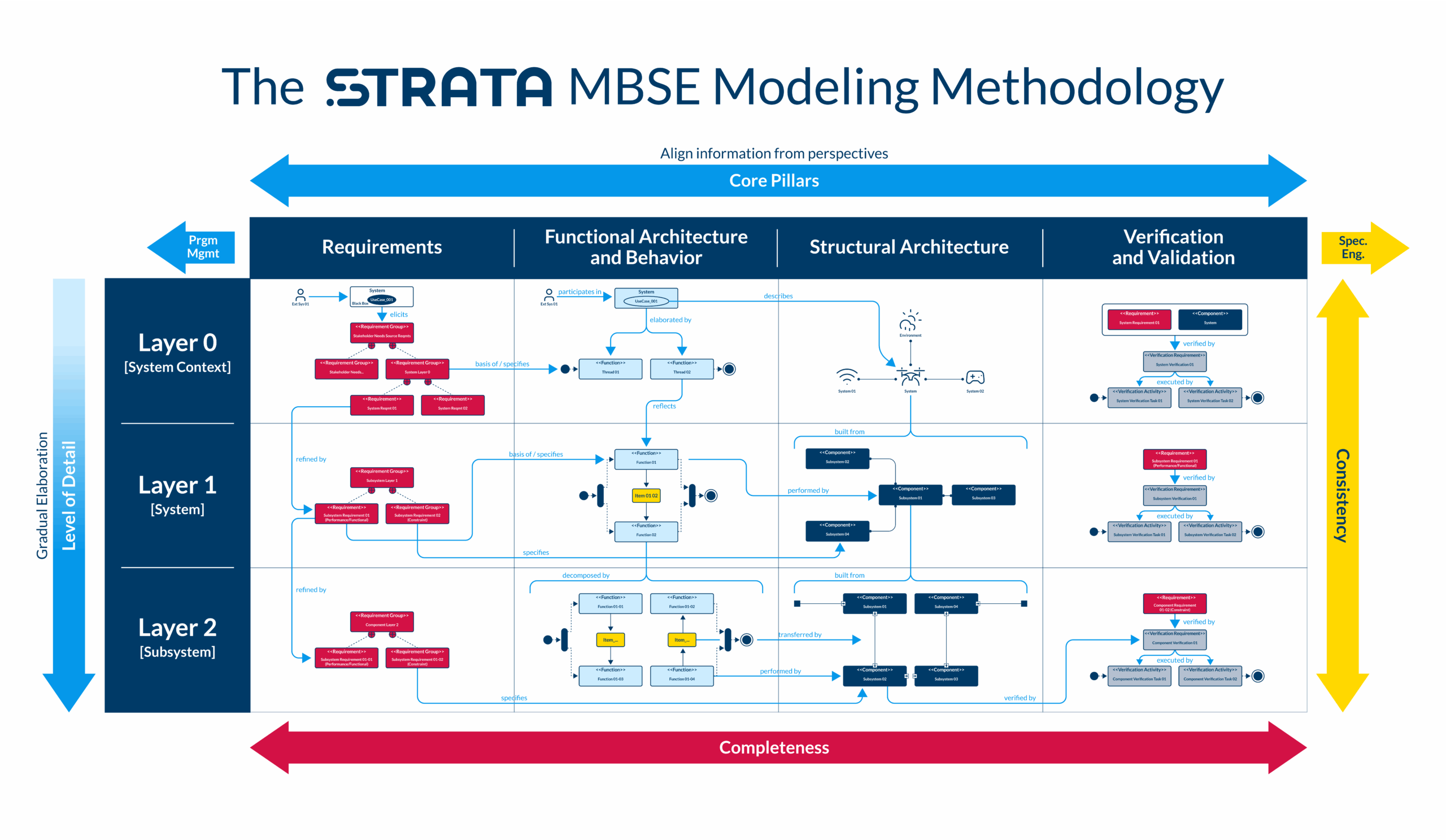
STRATA is all about decomposition and relation management. Some methodologies do not sufficiently emphasize decomposition or manage it holistically. That’s truly the beauty of the STRATA methodology: it provides a sound framework for decomposition. It breaks complexity into increasingly finer pieces that engineers can understand on their own while maintaining relationships across requirements, behavior, structure, and verification. In short, STRATA provides a simplified, holistic, and effective way to capture system knowledge.
Step 1: Establishing the System Model
Before diving into STRATA, it’s essential to define the system scope and establish an initial structured model. This involves:
Identifying Stakeholder Needs
Capture the high-level requirements and constraints from your customer. If possible, start with the original stakeholder need statements—the requirements—and analyze them for issues and concerns. Have difficult conversations with your customer early to clarify the requirements and assess their feasibility.
Defining System Boundaries
Establish what is inside and outside the system. This provides a basis for architecture and interfaces. Understanding where your system begins and ends is vital to forming your physical architecture and managing the interfaces. In today’s complex system development projects, interface management is critical because interface issues can create integration challenges. The more we understand, clarify, and properly communicate the architecture at every level, the stronger the foundation for system development becomes.
Selecting the Right Modeling Language
Use CSDL and/or SysML to structure the model. Apply the language consistently across the program, so engineering disciplines use the same terms and relationships to convey meaning.
Choosing the Right Tool
Use GENESYS or another full-featured modeling tool that recognizes system decomposition and helps manage relationships and dependencies. A good tool is essential to implementing the MBSE methodology effectively.
Start With What You Know
STRATA allows engineers to start with what they know, regardless of where it fits in the system hierarchy. This flexibility ensures that early modeling efforts remain valuable as the system evolves.
Start by modeling the information you have. For example, if you have already defined your basic system hierarchy down to a subsystem level, build the System Layer (Layer 1) and Subsystem Layer (Layer 2) structural architectures. Then connect the two layers using the appropriate hierarchical relationships for components and linkages.
At this point, follow the process in each layer. Derive the functional architecture for Layer 1 and then Layer 2. Then connect the layers with the hierarchical relationships. This process reveals what’s next: derive the requirements for each layer. If subsystem requirements don’t yet exist, derive them from the functional architecture you just created. Then connect those requirements to the functions that informed them. Don’t forget about verification. As your requirements and architecture develop, define how you will verify each requirement and maintain traceability. As the STRATA process unfolds and the model builds more depth, the missing pieces of the system design will become evident as holes in the relationships emerge.
Step 2: Layered Decomposition in the MBSE Methodology
STRATA organizes systems into layers of increasing granularity to structure decomposition while maintaining traceability. While the framework provides a set of default layers, the names and structure are fully customizable to fit your organization’s terminology and needs. The default layers include:
- System Context Layer (L0) – Defines the external environment and mission.
- System Layer (L1) – Captures high-level system requirements and architecture.
- Subsystem Layer (L2) – Breaks down the system into functional subsystems.
- Component Layer (L3 and beyond) – Defines individual components and their interactions.
Each layer builds upon the previous one, supporting logical consistency while allowing for iteration between levels. How each layer builds up becomes obvious after you’ve captured the initial systems knowledge in the model. Look for the gaps: are the requirements complete? Are you missing the verification aspects of your System Context Layer (L0)? Don’t you need to ensure you can verify those system-level requirements? Have you fully developed the behavioral aspects of the layer?
Know When to Stop Modeling
Model to the level that makes sense for your needs. This is sometimes easier said than done, and engineers often ask, “When do I stop modeling?” There is no simple answer, but if you’re modeling for its own sake, you’ve probably gone too far. Modeling a layer should focus on its output. If you need to create a subsystem specification, model completely through the subsystem layer; you’ll find the data needed to develop that specification. When you can answer the need, you’ve completed a layer. The goal of each layer is to produce what you need. That might include a specification, an interface control document, a V&V plan, or a combination of these.
Step 3: Cross-Pillar Alignment – Ensuring Consistency
STRATA integrates four core perspectives:
- Requirements – Capturing stakeholder needs and constraints.
- Functional Architecture and Behavior – Defining system operations and interactions.
- Structural Architecture – Structuring components and their relationships.
- Verification and Validation (V&V) – Ensuring correctness through testing and analysis.
Changes in one pillar can impact the others, requiring continuous alignment. STRATA provides relationships that help engineers trace those impacts across layers or perspectives. As you model a layer, make sure your work aligns with the layers above and below it. Alignment is a key aspect of STRATA. Understanding how each model element relates to its parent and child layers is critical to understanding the full perspective. These relationships also help you confirm that each layer properly decomposes its parent and adds useful detail.
Too often, engineers decompose concepts and model elements with little thought given to why that decomposition is necessary. Maintaining traceability to the parent element helps confirm that the decomposition adds deeper understanding rather than simply adding detail.
Understanding the impact of a change is crucial in systems engineering. Ensuring traceability between levels gives the systems engineer clear insight into the impact of changes. When something changes at the level you’re currently working on, you can instantly assess its impact on the lower level and confirm that it still aligns with the higher level. This sounds like common sense, but in practice, engineers can lose sight of the broader architecture when they focus on a single physical layer at a time.
Step 4: Iterative Refinement – Managing Complexity
Unlike traditional waterfall methodologies, STRATA recognizes that system development is iterative. Engineers must:
- Refine requirements as new insights emerge.
- Adjust architecture based on feasibility analysis.
- Validate assumptions through simulations and testing.
- Ensure traceability between layers to maintain system integrity.
STRATA’s structured approach helps teams manage changes systematically and reduce the risk of costly rework and misalignment. Complete the layers to the best of your knowledge at the time. The model and each layer will grow and change as your team’s understanding evolves. Don’t be afraid to rework portions of a layer as new knowledge becomes available. Use relationships to other parts of the system to inform those updates while maintaining traceability up and down the layers.
Step 5: Using GENESYS to Support STRATA Implementation
GENESYS supports STRATA implementation by:
- Managing relationships between system elements.
- Generating diagrams to visualize dependencies.
- Supporting simulations to validate system behavior.
- Providing consistency checks to ensure model integrity.
By using STRATA with GENESYS, engineers can support alignment across the model as system development progresses. GENESYS helps engineers maintain a holistic view of the system across multiple layers of decomposition by putting entities and relationships at the center of the model. Models are easy to navigate because GENESYS clearly shows engineers the relationships among entities.
GENESYS constructs diagrams directly from the underlying model. Conversely, when an engineer creates a diagram, GENESYS updates the model accordingly. This language-first approach is core to how GENESYS works. It helps engineers understand system relationships and supports model consistency as the design evolves.
Conclusion
Implementing STRATA MBSE methodology requires a structured, iterative approach that balances layered decomposition, cross-pillar alignment, and continuous refinement. By leveraging CSDL, GENESYS, and strategic layering, engineers can manage complexity while keeping system information connected across layers and domains.
Next Step
Ready to put the STRATA MBSE methodology into practice? Explore how GENESYS supports layered system modeling, traceability, and iterative development—or contact the Zuken team to discuss your MBSE goals.
Related Reading
- Managing Complexity with the STRATA Methodology
- The Power of MBSE Modeling Language Extensibility with CSDL

-
Vice President of Marketing for Zuken USA


- Blog

- Blog

- Blog

- Blog
Related Products and Resources

- Pages

- Products

- Blog
- Products
Digital Engineering requires a model-based design process that begins in Systems Engineering. Zuken acquired Vitech Corporation, a leader in Systems Engineering practices and MBSE solutions, with the intent of implementing an E/E model-based design process.