
The Power of MBSE Modeling Language Extensibility with CSDL
Systems engineering teams rarely work with one-size-fits-all processes. Each organization has its own terminology, standards, risk methods, reporting needs, and engineering practices.
That creates a common challenge for MBSE teams. How do you tailor a system model to fit a specific domain without sacrificing consistency, traceability, or interoperability?
That is where MBSE modeling language extensibility becomes important.
More specifically, extensibility allows teams to adapt a modeling language for their own needs while preserving its core structure. In GENESYS, the Comprehensive System Design Language (CSDL) provides the foundation for systems modeling. Teams can extend that foundation with custom classes, attributes, and relationships that reflect domain-specific engineering needs.
When teams apply it effectively, extensibility helps teams keep more engineering knowledge inside the model. It also reduces the need for disconnected spreadsheets, documents, and informal workarounds.
What Is MBSE Modeling Language Extensibility?
A modeling language defines the types of information engineers can capture. This may include physical, functional, RV&V, programmatic, and specialty engineering elements. However, no two programs or organizations describe their systems in exactly the same way.
One team may need to capture medical device risk data. Another may need to connect failure modes to system functions. A third may need custom attributes for compliance, reporting, or enterprise review.
Extensibility gives teams a controlled way to add those concepts.
Think of extensibility as a plug-in capability for your modeling language. Instead of hardcoding every possible concept into the language, engineers can introduce specialized concepts when they need them. At the same time, the model keeps the structure needed for traceability and analysis.
Why MBSE Modeling Language Extensibility Matters
A strong modeling language should be expressive, precise, self-consistent, and complete. It should support the core systems engineering work that most programs need.
However, every enterprise, industry, and domain also has unique needs. Teams often need to tailor models for regulations, stakeholder language, internal processes, and specialized analyses.
MBSE modeling language extensibility helps address these needs in several ways.
First, extensibility helps teams adapt models to new domains
Different industries use different terminology and engineering practices. For example, medical device teams need to represent risk management concepts in a very specific manner. Aerospace and defense teams often need detailed failure analysis, mission logic, or interface controls with greater granularity for qualification and acceptance.
Second, extensibility helps teams support emerging technologies
As AI, IoT, autonomous systems, and digital twins become more common, models need to capture new behaviors, constraints, and relationships. New rules, properties, or relationships that couldn’t be known previously can be seamlessly integrated into the extended model.
Third, extensibility supports stakeholder communication
Organizations often need custom attributes, profiles, or extensions that reflect their processes and reporting needs. These additions help teams communicate in familiar terms without losing model rigor.
Finally, extensibility supports tool integration
Vendors and engineering teams can add extensions for simulation, analysis, reporting, or visualization. As a result, the model can support more of the digital engineering workflow, thereby enhancing interoperability.
By contrast, without extensibility, teams often create workarounds. They may store key information in spreadsheets, documents, or disconnected tools. That creates data sync risk. Costly rework is created. Traceability suffers.
Engineering data becomes harder to interpret. Over time, ambiguity spreads across the program.
Extensibility helps prevent that. It allows organizations to tailor the modeling language while maintaining a single source of truth for system design.
How GENESYS Implements CSDL Extensibility
GENESYS is built on CSDL and provides an MBSE modeling language extensibility through the schema editor. This framework gives teams flexibility while maintaining language integrity.
Teams can define new element types or specialize existing ones. They can add domain-specific attributes and parameters. They can also create relationship types that capture specialized interactions.
Importantly, these extensions do not sit outside the model. They become part of it. That means teams can query, trace, report, analyze, and visualize extended model elements alongside the rest of the system design.
GENESYS also supports semantic integrity and enforces precision. The framework validates extensions against core language rules. This helps prevent issues such as invalid relationships, circular dependencies, or violations of modeled constraints.
Teams can also define custom completeness and integrity rules. These rules help ensure that models meet enterprise-specific standards and quality checks.
Integration matters as well. Through APIs and scripting, GENESYS can connect with external tools for simulation, analysis, and visualization. At the same time, the CSDL-based model remains the authoritative source of engineering data. Zuken positions GENESYS as an MBSE platform with an information framework, systems engineering diagnostics, and model assistants to support complex systems engineering work.
Examples of MBSE Modeling Language Extensibility in Action
The value of extensibility becomes clearer through examples. Two useful cases are regulatory compliance and failure analysis.
The first example focuses on ISO 14971 compliance in the medical device industry. The second focuses on Failure Modes and Effects Analysis, or FMEA. Both show how language extensions can improve traceability and keep important engineering data connected to system architecture.
Example 1: Extending GENESYS for ISO 14971 Compliance
ISO 14971 is the international standard for medical device risk management. It requires manufacturers to identify hazards, estimate and evaluate risks, and implement controls throughout the product lifecycle.
For medical device teams, risk management cannot sit apart from the system model. Intended use, reasonably foreseeable misuse, hazards, controls, requirements, and verification evidence all need to stay connected.
A CSDL language extension can help.
In this example, an ISO 14971 extension embeds medical device risk concepts directly into the GENESYS modeling environment. This reduces the need for external spreadsheets and documents. It also improves traceability because compliance-related data stays connected to the model.
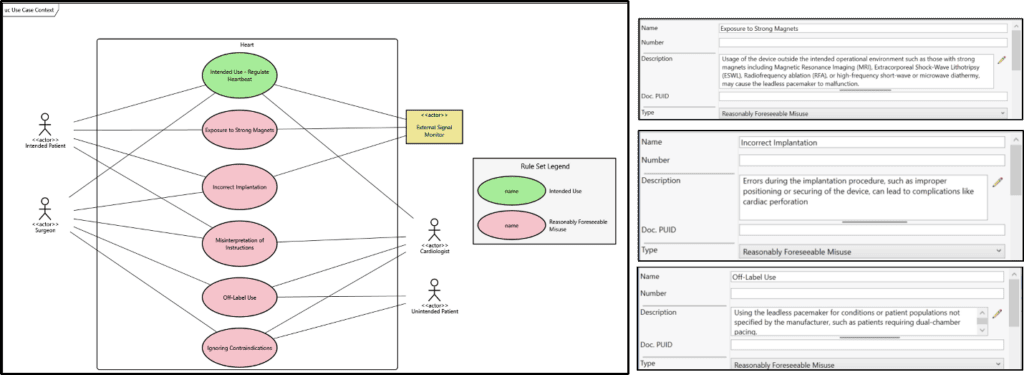
One practical part of the extension focuses on intended use and reasonably foreseeable misuse.
ISO 14971 requires teams to identify and document both. In GENESYS, the closest existing class for these concepts is Use Case. The Use Case class already includes many useful attributes. To support ISO 14971 compliance, the team created a specialized Use Case class and added attributes specified by the standard.
One of those attributes is “type.” The model represents it as an enumeration with two values: intended use and reasonably foreseeable misuse.
This extension allows modelers to distinguish expected use from off-nominal misuse scenarios. Teams can also make those distinctions visible in diagrams through customized coloring rules and legends.
As a result, engineers can analyze risk factors more systematically. They can also link use cases to mitigation strategies, requirements, and verification activities. Zuken’s medical device MBSE material similarly frames integrated risk management as a way to keep risk analysis embedded in the system architecture rather than isolated in separate documents.
Example 2: Extending GENESYS for FMEA
Failure Modes and Effects Analysis, or FMEA, is a structured method for identifying potential failure modes in a system. Teams use it to assess effects and prioritize actions that reduce risk.
FMEA is widely used in industries such as automotive, aerospace, and medical devices.
However, many teams still manage FMEA in spreadsheets. That creates a gap between risk analysis and system architecture.
A CSDL extension can close that gap.
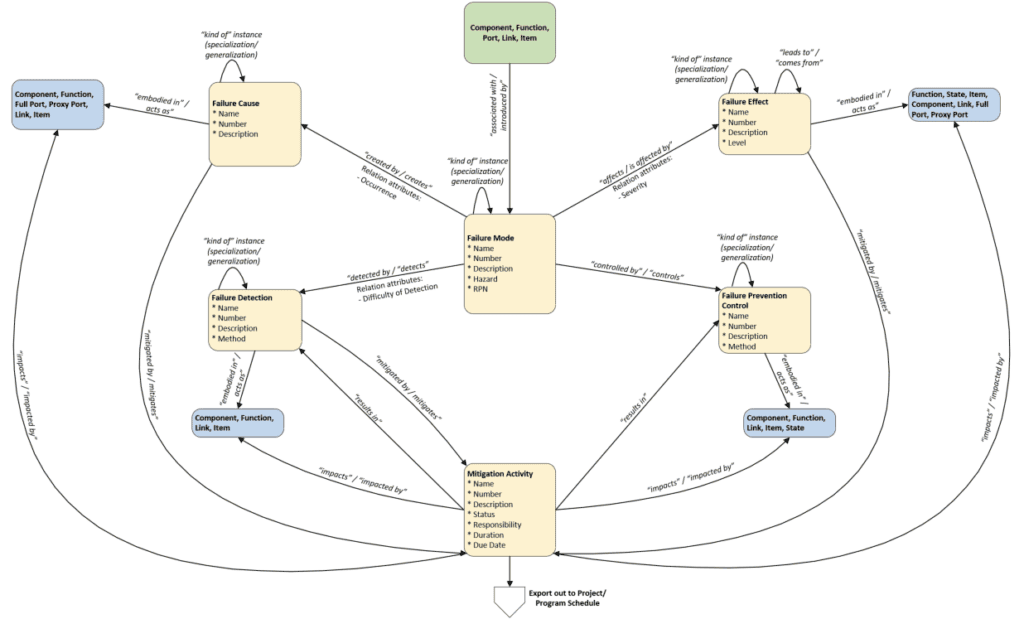
With a FMEA extension in GENESYS, teams can capture failure analysis concepts directly within the system model. These concepts may include failure modes, effects, causes, detection methods, prevention controls, severity, occurrence, and detection ratings.
For example, engineers can link failure modes to specific components, functions, ports, links, or items. They can also store severity, occurrence, and detection ratings as relationship attributes.
This approach makes FMEA part of the model instead of a separate artifact.
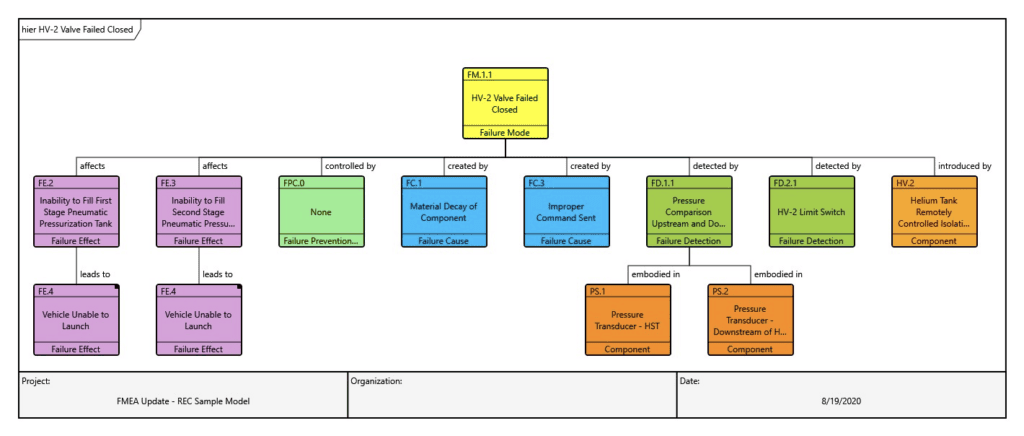
That matters because architecture and risk analysis often change together. If a component changes, teams need to understand which failure modes, requirements, functions, and mitigations are affected. When FMEA data lives in the model, engineers can trace those relationships more easily.
They can also visualize risk relationships and generate reports from model data. This improves consistency and reduces the manual effort required to reconcile disconnected spreadsheets.
Extensibility Requires Governance
Extensibility is powerful, but teams should use it carefully.
Poorly planned extensions can create problems. Teams may introduce duplicate concepts, inconsistent naming, or relationships that are difficult to interpret. Extensions can also create interoperability challenges with other tools and standards.
Good governance reduces those risks.
Teams should document the purpose of each extension. They should define ownership and naming conventions. They should reuse existing classes when possible. They should also validate extensions through completeness and integrity rules.
A useful test is simple: does this extension make the model more precise, traceable, and useful?
If the answer is yes, the extension likely adds value. If the extension only adds terminology without improving analysis, reporting, or communication, it may create unnecessary complexity.
The goal is not unlimited customization. The goal is disciplined flexibility.
Extensible MBSE Models Support the Digital Engineering Thread
As organizations move toward digital engineering, models need to connect more engineering information across the lifecycle. Requirements, architecture, behavior, risk, verification, compliance, and analysis must work together.
MBSE modeling language extensibility helps make that possible.
With CSDL and GENESYS, teams can tailor models to their domain while preserving structure and traceability. They can capture specialized engineering concepts directly in the model. They can also keep those concepts connected to requirements, functions, components, interfaces, and verification evidence.
That balance matters. A model must reflect real engineering practice. It must also remain consistent enough to support analysis, decision-making, reporting, and collaboration.
GENESYS supports that balance by combining an extensible modeling foundation with model access, diagnostics, and collaboration capabilities. Zuken also describes SIDEKICK as a web-based companion that expands model access and structured review workflows across engineering, quality, project management, and customer teams.
Ready to Build More Adaptable System Models?
Extensible MBSE helps teams move beyond one-size-fits-all modeling. With CSDL and GENESYS, organizations can tailor their modeling language while preserving traceability, consistency, and model integrity.
Explore MBSE with GENESYS to see how an extensible modeling environment can support compliance, FMEA, risk analysis, and enterprise engineering workflows.
Editor’s note: MBSE modeling language extensibility examples originally provided by Brian Selvy.

-
Solutions Architect

- Blog

- Blog

- Blog

- Blog
Related Products and Resources

- Pages

- Products

- Blog
- Products
Digital Engineering requires a model-based design process that begins in Systems Engineering. Zuken acquired Vitech Corporation, a leader in Systems Engineering practices and MBSE solutions, with the intent of implementing an E/E model-based design process.