Managing Complexity with the STRATA Methodology
Introduction
In complex systems engineering, teams often struggle to connect requirements, behaviors, components, and verification into a coherent model. The STRATA methodology helps manage that complexity by structuring system design in logical layers—keeping teams aligned, models consistent, and decisions traceable.
The Core of the STRATA Methodology
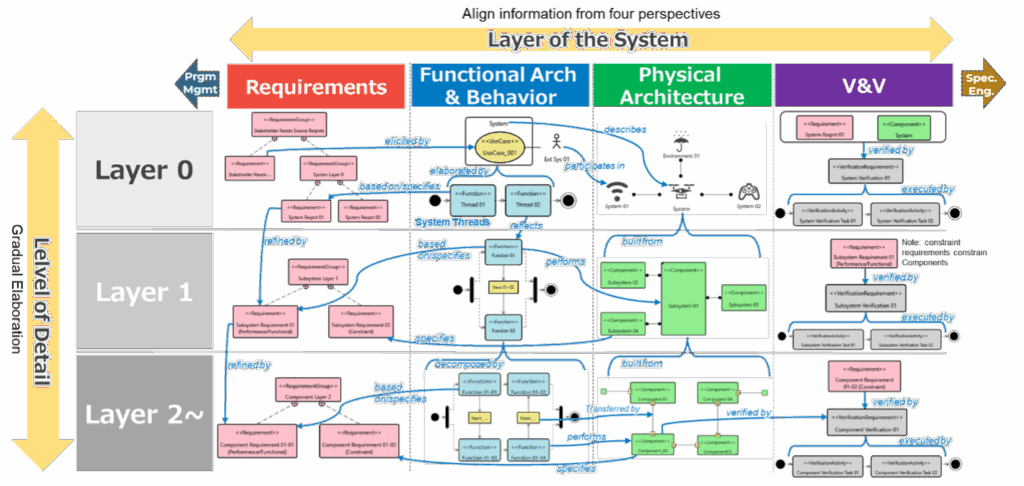
STRATA, short for strategic layers, provides a framework for organizing system data. It breaks systems into manageable layers and connects them through four main pillars:
- Requirements
- Functional architecture and behavior
- Physical architecture
- Verification and validation (V&V)
Each layer adds detail while maintaining traceability. This structured approach allows engineers to model what they know and identify what they don’t—exposing gaps early in the process.
Three Pillars of MBSE
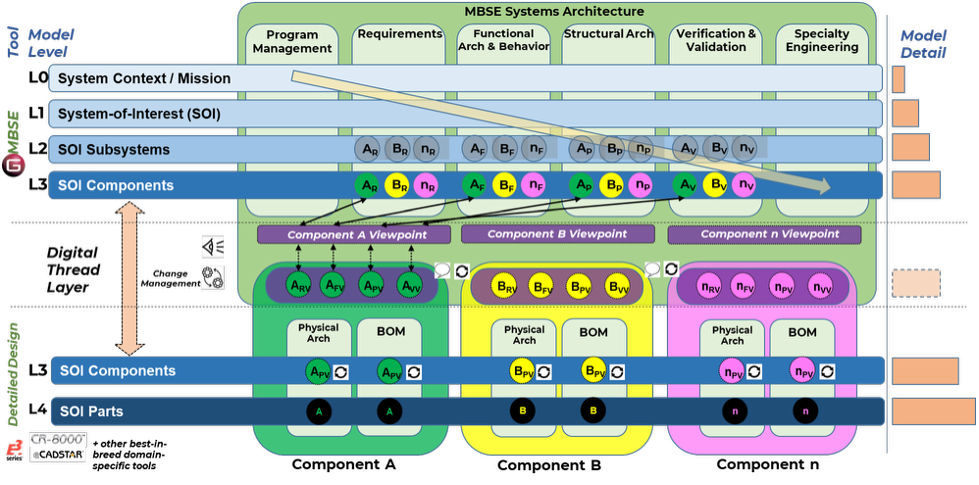
STRATA fits within the three fundamental pillars of Model-Based Systems Engineering (MBSE): language, methodology, and tooling.
- Language: STRATA uses the Comprehensive Systems Design Language (CSDL), a natural-language approach that describes systems using nouns, verbs, and relationships.
- Methodology: It provides structured tasks and best practices to ensure team-wide consistency.
- Tooling: Tools like GENESYS implement both STRATA and CSDL, enabling integrity checks, visualization, and shared collaboration.
Managing Complexity Through Layers
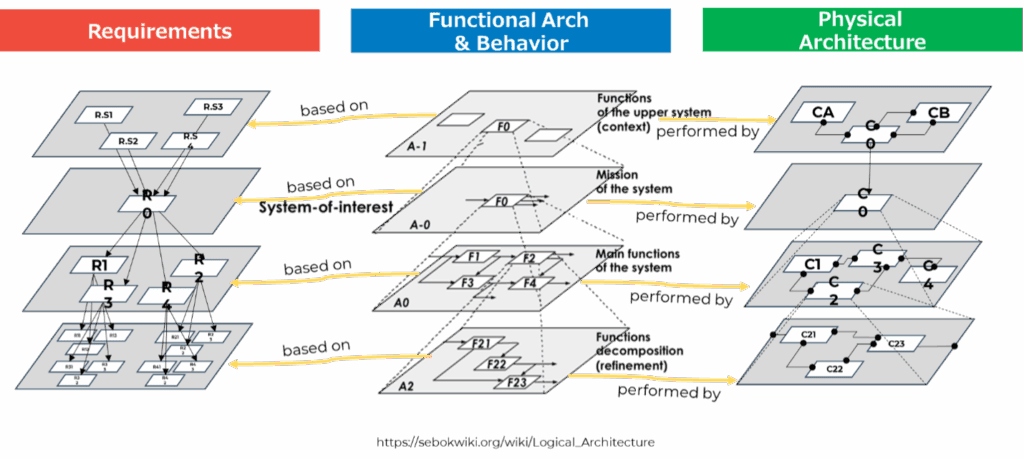
The strength of STRATA lies in decomposing complex systems into layers while preserving the links between them. A change in one layer—say, a function or requirement—can affect both higher and lower levels. STRATA helps engineers track these ripple effects to prevent design drift and ensure alignment between requirements, behavior, and architecture.
Integrating CSDL with STRATA
The Comprehensive Systems Design Language complements STRATA by providing a common modeling language. Instead of relying on cryptic notations, engineers describe relationships in plain language, making models accessible to stakeholders across disciplines. CSDL also supports framework mapping and automated checks for completeness and consistency.
The Three Systems of Interest
STRATA considers three interrelated systems:
- System of Interest (SOI): The system being designed, tested, and delivered.
- Context System: The environment in which the SOI operates, including users and external systems.
- Designing System: The organization that designs and manages the SOI, including its tools, processes, and people.
Modeling all three helps engineers see how design, enterprise, and operational factors interact—reducing risk and strengthening traceability.
Connecting STRATA to the Digital Thread
STRATA integrates seamlessly into the digital engineering ecosystem. Its structured model enables smooth data exchange with downstream design tools. When a design change occurs, STRATA makes it easy to assess its impact on requirements, behaviors, and verification activities—closing the loop between modeling and implementation.
A Simple Example: Modeling an Aircraft
A simplified aircraft model demonstrates STRATA in action. Requirements such as passenger capacity and range are directly linked to functions like flying or transporting baggage. Components, such as wings or fuselage, are tied to those functions, while missing verification links highlight where more detail is needed. STRATA makes these gaps visible so teams can resolve them early.
Takeaways
- A defined methodology like STRATA ensures complete, consistent, and correct system models.
- Integration across MBSE pillars enables accuracy and collaboration.
- STRATA helps teams manage complexity and maintain a single source of truth.
Conclusion
The STRATA methodology offers more than structure—it builds confidence. By layering detail, maintaining relationships, and enabling clear communication, STRATA provides a roadmap for managing engineering complexity. Combined with CSDL and GENESYS, it enables teams to deliver smarter, more reliable systems more quickly.
Learn more about the STRATA methodology and GENESYS software with these additional resources:

-
GENESYS Product Manager and Principal Systems Engineer at Zuken Vitech

Andy Henderson is the GENESYS Product Manager and Principal Systems Engineer at Vitech, helping systems engineering teams get more from model-based systems engineering. He develops scripts and simulations to tackle complex engineering challenges and uses that hands-on experience to drive innovation in the GENESYS product.
- Blog

- Blog

- Blog

- Blog