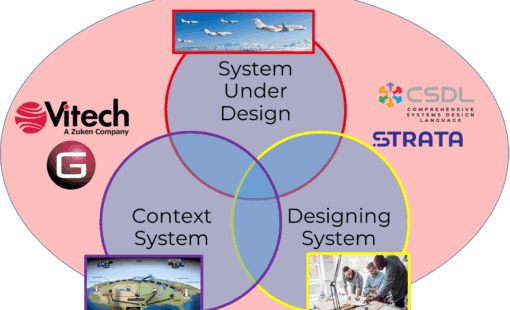
From Operational Context to System Definition: Mission Engineering Basics for Systems Designers
Modern systems must perform in complex, fast-changing operational environments. However, many engineering programs still struggle to translate real mission needs into clear system definitions. Operators describe what they need to accomplish. Engineers describe architectures, requirements, and models. Too often, those perspectives never fully align.
That disconnect is exactly why mission engineering basics matter. Mission engineering gives teams a structured way to connect operational intent to system design decisions—before they make costly commitments.
The Gap Between Operators and Designers
Think about how a fighter pilot describes a mission. They focus on airspace, timing, threats, coordination, and rules of engagement. In other words, each action reflects context and consequence.
Now compare that with how a systems designer describes the same aircraft. The conversation shifts to requirements, functional allocations, interfaces, and performance margins. Both viewpoints make sense. The problem starts when teams fail to connect them early and explicitly.
Program managers see the same tension. End users prioritize mission success and flexibility. Meanwhile, engineers prioritize feasibility, performance, and compliance. As a result, teams misalign, misunderstand each other, and delay decisions. Then the program pays for it with rework, overdesign, and missed operational goals.
Mission engineering closes this gap by defining why a system exists, what mission it supports, and how teams will measure success—before design details harden.
How Mission Engineering Clarifies System Purpose
At its core, mission engineering centers on four foundational questions:
-
What mission is being performed?
-
Who are the users and stakeholders involved?
-
What capabilities are required to succeed?
-
How effective must the system be in real operational conditions?
When teams answer these questions early, systems designers gain immediate advantages:
-
Clear system purpose: The mission anchors what the system must achieve, not just what it must do.
-
Early stakeholder alignment: Teams identify operational interfaces and expectations before assumptions spread.
-
Reduced complexity: Teams can challenge capabilities that do not create mission value.
-
Broader context awareness: Teams include organizational, ethical, and other non-technical constraints alongside technical drivers.
-
More resilient designs: Teams explore future operational needs without having to restart from scratch.
Mission engineering does not replace systems engineering. Instead, it strengthens it by grounding design decisions in operational reality.
Applying Mission Engineering in Practice
To see how mission engineering works day to day, consider a program tasked with replacing an aging multi-role fighter aircraft.
Mission Decomposition
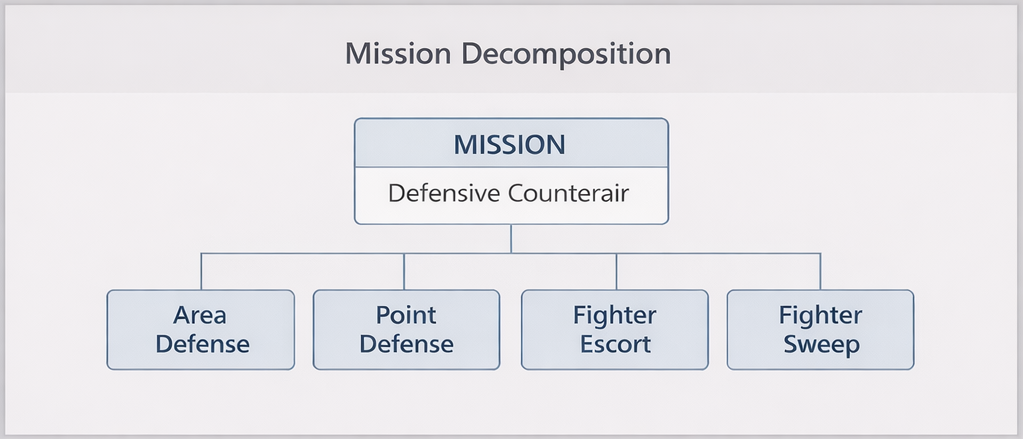
First, engineers identify top-level missions such as Offensive Counterair and Defensive Counterair. Next, they decompose these into executable missions, such as Fighter Escort, Fighter Sweep, Area Defense, Point Defense, and High-Value Asset Protection.
Although Area Defense and Point Defense may drive the new aircraft requirement, laying out all missions in context often reveals alternatives. For example, existing platforms already supporting related missions may meet the need with upgrades. In that case, the program can modernize an existing aircraft instead of launching a new acquisition. As a result, the team avoids cost, schedule risk, and integration complexity.
Capability Identification
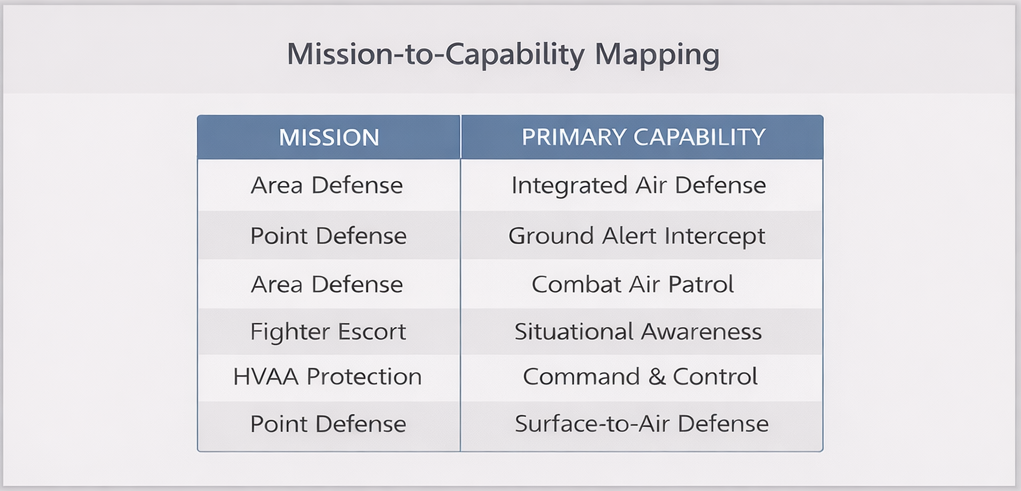
After the team selects missions, they identify the capabilities required to execute them. For Point and Area Defense, those capabilities might include Combat Air Patrol, Ground Alert Intercept, Integrated Air Defense, or Surface-to-Air Defense.
Then, by mapping missions to known capability hierarchies, engineers can see where existing systems already deliver value. Consequently, the team may shift from “build a new platform” to “integrate and extend proven capabilities.”
Mission Threads and Mission Engineering Threads
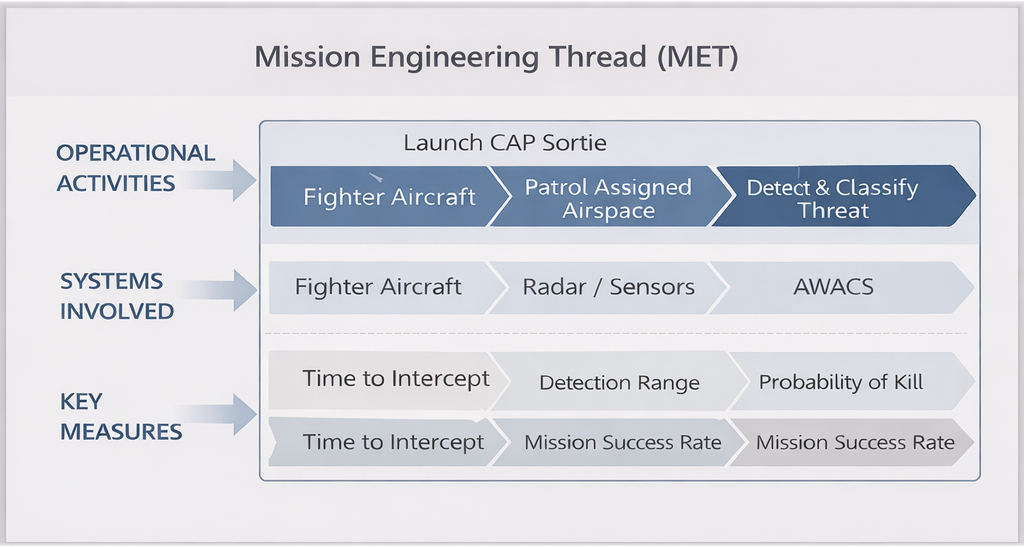
Next, engineers develop Mission Threads (MTs) and Mission Engineering Threads (METs) to describe end-to-end mission execution. For instance, one MET might represent a combat air patrol supported by an airborne warning and control system.
These threads make the mission concrete. They also expose operational activities, participating systems, performance drivers, and implementing functions. Most importantly, they bridge operational context into system implementation.
Informing Trade Studies with Operational Insight
Once engineers define METs, they can run them across different scenarios, assumptions, and constraints. Each variation yields a consistent set of operational activities, capabilities, systems, and performance parameters.
Then, teams feed those outputs into trade studies. Instead of comparing architectures solely on technical compliance, engineers compare them on mission effectiveness. As a result, teams surface gaps, sensitivities, and risk areas earlier—when they can still adjust the design without significant disruption.
At the same time, keep expectations realistic: METs do not replace discipline-specific models. Instead, mission models provide the operational frame that helps teams interpret other engineering models and analyses consistently.
Scaling Mission Engineering with MBSE
Before they formalize mission engineering basics, many organizations already practice pieces of it. For example, teams develop user journeys, conduct concept studies, and run focus groups. Those activities capture mission context, but they often live in disconnected documents.
MBSE changes that. When teams formalize mission engineering in a model-based approach, they improve traceability, preserve intent, and protect data integrity as designs change. In addition, they make mission context reusable across variants, upgrades, and future programs—without re-creating foundational work each time.
Mission Engineering as a Design Advantage
Mission engineering basics give systems designers a practical advantage. By starting with operational context, teams make stronger decisions earlier, reduce unnecessary complexity, and align stakeholders around mission outcomes.
As systems become more interconnected and operational environments more demanding, this approach becomes less optional. Instead, it increasingly acts as a prerequisite for effective system definition.
Put Mission Engineering Into Practice
If you want a practical walkthrough of these concepts, watch the companion webinar: “From Operational Context to System Definition: Mission Engineering Basics for Systems Designers.” Then, use that foundation to evaluate how mission context, mission threads, and operational measures can stay traceable as requirements and architectures evolve.
If you’re exploring MBSE workflows, take one of these next steps:
-
Explore MBSE with GENESYS to see how a model-based approach supports system definition and lifecycle traceability.
-
Review GENESYS key features to understand how teams maintain consistency from early context through validation.
-
If you work across multiple platforms, consider a systems-of-systems approach so interdependencies become part of the design, not late surprises.
Want to see what this looks like for your program? Contact our team to discuss how to model mission context and threads in a way that supports architecture decisions, trade studies, and stakeholder alignment.

- Blog
- Blog

- Blog

- Blog