
A Better Approach to Aerospace EWIS Design and Documentation
Aerospace programs depend on precision. Yet even strong engineering work can lose value when documentation is inconsistent, incomplete, or spread across disconnected systems. That is especially true in the design of the Aerospace Electrical Wiring Interconnection System (EWIS), where electrical definitions must remain accurate from concept through manufacturing, installation, and support.
EWIS includes wires, connectors, terminals, splices, and related components that distribute power and signals throughout an aircraft. These systems are highly detailed, tightly regulated, and deeply connected to production quality. When documentation breaks down, the effects travel quickly. Engineering teams lose time. Manufacturing teams build from unclear instructions. Suppliers work from outdated data. Program risk increases.
A better approach starts with one principle: treat EWIS documentation as part of the design, not a downstream byproduct.
The Problem: Fragmented EWIS Definitions Create Downstream Risk
Many aerospace teams still manage EWIS information across multiple formats and tools. Schematic data may reside in a single system. Wire lists may be exported to spreadsheets. Connector details may appear in PDFs or drawings. Change notes may sit in email threads or review comments. Each item may seem manageable on its own, but together they create a documentation gap.
That gap becomes expensive when programs move faster, supplier involvement grows, and configuration complexity increases.
Common problems include:
- mismatched wire or connector definitions between design and build documents.
- unclear release status for drawings and reports.
- manual updates that do not carry across every output.
- delayed discovery of changes until production or installation.
- limited traceability when questions arise during testing or service.
In aerospace environments, these issues are not minor inconveniences. A missing update or an inconsistent reference can trigger rework, slow approvals, or cause installation problems that are difficult to resolve later. As programs grow more complex, fragmented documentation becomes a business risk, not just an engineering annoyance.

Why Consistent Documentation Improves Aerospace EWIS Design
Good EWIS design is more than correct connectivity. It also requires a consistent definition of that connectivity across every document used by engineering, manufacturing, quality, and suppliers.
When documentation is controlled, teams gain a clearer picture of the product. Wire IDs, pin assignments, device references, and supporting reports stay aligned. Review cycles move faster because teams are comparing the same source of truth. Manufacturing can trust that released outputs reflect the current design.
Consistent documentation strengthens the design of aerospace EWIS in several ways.
First, it improves communication across disciplines. Electrical, mechanical, manufacturing, and quality teams all depend on clear data handoffs. Controlled documentation helps each group understand the intended design without having to interpret conflicting files.
Second, it supports traceability. Aerospace teams need confidence in what has changed, why it changed, and where that change appears. Revision-controlled documentation makes impact analysis easier and reduces the chance of hidden downstream errors.
Third, it improves design maturity. When teams spend less time reconciling files, they can focus more on validation, optimization, and release readiness.
How a Connected Design Environment Supports EWIS Documentation
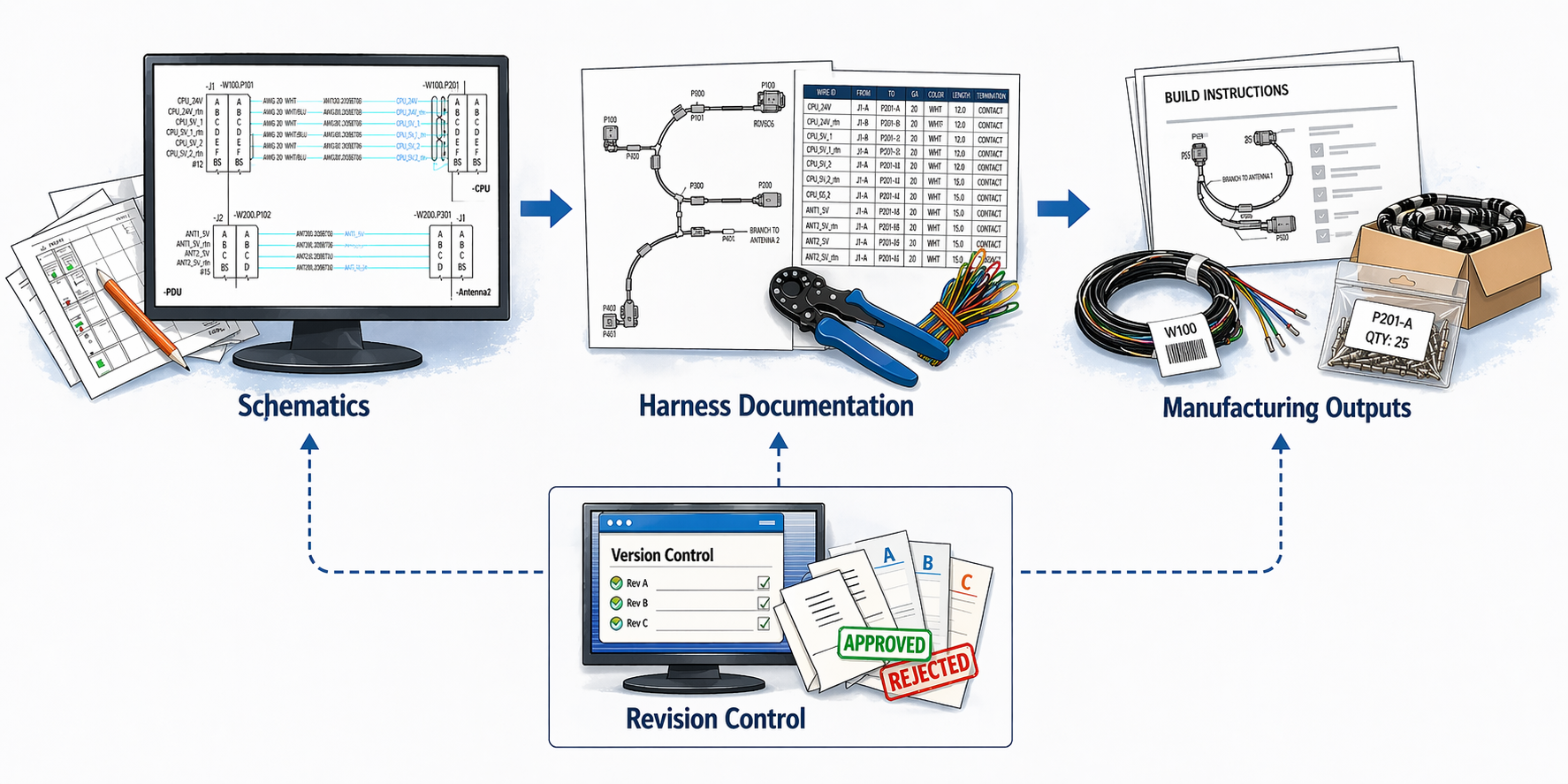
The most effective way to improve documentation is to reduce fragmentation at the source. A connected design environment keeps schematic data, harness definitions, reports, and documentation outputs synchronized as the design evolves.
That matters because aerospace EWIS design changes often. Connector selections shift. Routing assumptions evolve. Requirements move. Supplier inputs change. If documentation depends on manual updates, it quickly falls behind the actual design.
Connected platforms help teams avoid that problem by:
- Maintaining a shared source of electrical design data.
- Generating wire lists, reports, and other outputs directly from the current design.
- Standardizing documentation templates and naming conventions.
- Improving approval visibility and revision control.
- Reducing duplicate entries across disconnected files.
For teams using Zuken solutions, this approach can combine intelligent design in E3.series with structured control in DS-E3. E3.series supports accurate electrical and wiring design, while DS-E3 helps govern project files, revisions, and release status. Together, they help teams manage EWIS documentation as a controlled engineering asset rather than a collection of loosely related files.
That connected approach is especially valuable when collaborating with suppliers or distributed teams. Everyone has access to the correct package, with better visibility into approval state and change history.
Business Benefits: Fewer Errors, Faster Builds, Better Compliance Readiness
Better documentation does more than keep files organized. It improves program execution.
When EWIS documentation is accurate and consistent, manufacturing teams spend less time resolving ambiguity. Suppliers receive clearer build instructions. Engineering teams reduce last-minute corrections. Quality teams gain stronger traceability during audits and investigations.
The business benefits are tangible:
- Fewer production delays are caused by documentation mismatches.
- Reduced rework and scrap from wiring errors.
- Faster ECO and change review cycles.
- Better supplier coordination and release confidence.
- Stronger support for certification, verification, and service documentation.
These benefits matter because aerospace schedules leave little room for preventable mistakes. Every unclear revision or missing update adds friction. Over time, that friction slows programs, raises costs, and weakens confidence in the design baseline.
A better documentation process helps teams protect margin while improving reliability.
Conclusion: Aerospace EWIS Design Needs Documentation You Can Trust
As aerospace systems become more complex, documentation quality becomes a bigger competitive advantage. Teams cannot afford to manage EWIS definitions through disconnected spreadsheets, static files, and unclear revisions.
A better approach to aerospace EWIS design starts with accurate, controlled, and connected documentation. When wiring definitions remain consistent across design, review, and manufacturing, teams reduce risk and improve execution at every stage of the program.
For organizations looking to strengthen EWIS design workflows, Zuken solutions such as E3.series and DS-E3 can help unify electrical design data, improve revision control, and generate documentation with greater confidence.

-
Applications Engineer


- Blog

- Blog

- Blog

- Blog
Related Products and Resources
- Blog
- Blog

- Products
- Products
E3.series is a Windows-based, scalable, easy-to-learn system for the design of wiring and control systems, hydraulics and pneumatics. The out-of-the-box solution includes schematic (for circuit and fluid diagrams), cable (for advanced electrical and fluid design), panel (for cabinet and panel layout), and formboard (for 1:1 wiring harness manufacturing drawings). Integrated with MCAD, E3.series is a complete design engineering solution from concept through physical realization and manufacturing output.